

Custom Large Format Vacuum Forming Machines for Sale
The vacuum forming process begins when a thermoplastic sheet is clamped and heated until it softens and becomes pliable. The heated plastic sheet is then brought into contact with the mold, and a vacuum draws the air from beneath it. Vacuum pressure pulls the sheet tight against the mold surface, and the part cools before it is released and trimmed to its final shape. This forming process is the same at any scale, but on a large format machine the sheet is much larger. Uniform heat, firm clamping and strong vacuum pressure across the full sheet decide whether oversized parts come out consistent. Tooling costs are lower than for injection molding, which makes this thermoforming process practical for prototypes, short runs and full production.
Common Uses of Large Format Vacuum Forming Machines
Large format vacuum forming machines are used in industrial manufacturing environments that require forming oversized plastic components with precision and repeatability. Common applications include automotive and aerospace parts, architectural and construction components, industrial packaging, and the production of spa shells and hot tub structures where uniform wall thickness and surface quality are critical.
Price Range for Large Format Vacuum Forming Machines
Large format vacuum forming machines typically range from $20,000 to over $150,000, depending on machine size, automation level, material capacity, and customization requirements. In industrial production environments, buyers should also account for long-term considerations such as maintenance, energy consumption, tooling integration, and application-specific engineering when evaluating overall value.
Call JB For A FREE Consultation On Your Project
30+ Years Experience Engineering & Sales You Can Trust!


PNEUMATIC CLAMPING


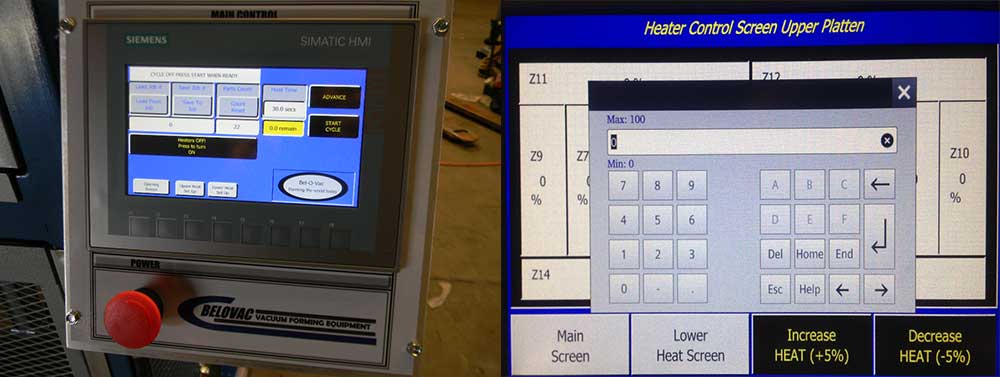
SIEMENS PLC TOUCH SCREEN HEAT CONTROL
Our Touch Screen PLC Control allows for precision timed automated sequencing and
Touch screen Heat Control 7 Zones Upper/Lower Oven banks.
HIGH WATT DENSITY UPPER HEATER BANK


About Our Large Format Vacuum Forming Machine
Machine Specifications
Belovac’s large format vacuum forming machines are engineered to process a wide range of industrial thermoplastics, including ABS, HIPS, KYDEX, acrylic, HDPE, polycarbonate, and other heavy-gauge materials. Precision heat control is achieved through a programmable solid-state heat timing unit combined with percentage-based zone control, allowing consistent and repeatable heating across large surface areas.
A fully adjustable material clamping system accommodates varying sheet sizes and thicknesses, making these machines well suited for forming oversized or complex components that require uniform pressure and dimensional accuracy throughout the forming cycle.
- Compatible with ABS, HIPS, KYDEX, acrylic, HDPE, polycarbonate, and most industrial thermoplastics
- Programmable solid-state heat timing with percentage-based heat control
- Fully adjustable material clamping for variable sheet sizes and thicknesses
AVAILABLE UPGRADES
Give your machine usability upgrades
LOWER RADIANT HEATER PANEL

Overhead Assist
24″ Stroke Recommended for inverted tools, deep draw pockets. multiple tool forming, outer-pinch mechanism.
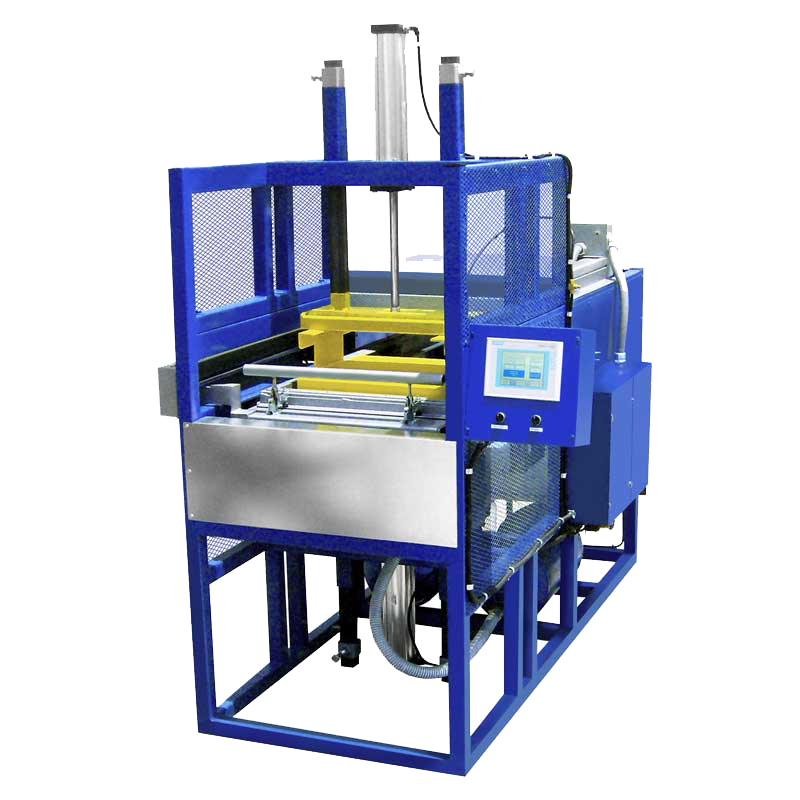
Large Format Vacuum Forming Machines for Industrial Thermoforming
Belovac designs and manufactures large format vacuum forming machines for industrial thermoforming applications requiring precision, durability, and repeatable performance at scale. Built for oversized plastic parts used in signage, bathtubs, spa shells, and complex industrial components, these systems are available in manual or fully automatic configurations to support both low-volume and high-volume production environments.
How the Large Format Vacuum Forming Process Works
The vacuum forming process begins when a thermoplastic sheet is clamped and heated until it softens and becomes pliable. The heated sheet is then brought into contact with the mold, and the vacuum creates suction that removes the air trapped beneath it. Vacuum pressure pulls the sheet tight against the mold surface, and the part cools before it is released and trimmed to its final shape. This forming process is the same at any scale, but on a large format machine the sheet is much larger. Uniform heat, firm clamping and strong vacuum pressure across the full sheet decide whether oversized parts come out consistent. Tooling costs are lower than for injection molding, which makes this thermoforming process practical for prototypes, short runs and full production.
Common Uses of Large Format Vacuum Forming Machines
Large format vacuum forming machines are used in industrial manufacturing environments that require forming oversized plastic components with consistent quality and dimensional accuracy. Common applications include automotive and aerospace parts, architectural and construction components, industrial packaging, and the production of spa shells and hot tub structures where uniform wall thickness and surface finish are critical.
Price Range for Large Format Vacuum Forming Machines
Large format vacuum forming machines typically range from $20,000 to over $150,000, depending on machine size, automation level, material capacity, and customization requirements. In industrial production settings, buyers should also consider long-term factors such as tooling integration, energy consumption, maintenance access, and application-specific engineering when evaluating overall value and return on investment.
Machine Specifications
Belovac’s large format vacuum forming machines are engineered to process a wide range of industrial thermoplastics and other plastic materials while maintaining consistent heating and forming pressure across large surface areas. Precision heat control is achieved through programmable solid-state timing combined with percentage-based zone control for repeatable results. The technical specifications below cover heat control, clamping, and material range.
- Compatible with ABS, HIPS, KYDEX, acrylic, HDPE, polycarbonate, PVC, ACR, and most industrial thermoplastics
- Programmable solid-state heat timing with percentage-based heat control
- Fully adjustable material clamping for variable sheet sizes and thicknesses
Key Features & Capabilities
Pneumatic Clamping & Vacuum Pressure
Heavy-gauge pneumatic clamping delivers up to 300 foot-pounds of pressure per linear foot, ensuring large plastic sheets remain securely positioned during forming. Integrated high-capacity vacuum systems generate deep vacuum levels for accurate mold definition and consistent part replication.
Advanced Siemens PLC Multi-Zone Heat Control
An onboard Siemens PLC touch screen controls seven heating zones across the oven banks, so operators can set the forming temperature zone by zone and profile the heat across the entire sheet. The upper heater bank is the primary heat source, and its high-watt density heating elements heat the sheet evenly, which keeps the manufacturing process repeatable. This uniform heat distribution minimizes hot and cold spots and is essential when forming flame-retardant or high-temperature materials. For thick gauge sheet, the optional lower radiant heater panel adds heat saturation and shortens cycle times.
Material Versatility & Custom Mold Support
Thermoplastics Supported
- ABS and HIPS (high-impact polystyrene) for rigid, impact-resistant components
- KYDEX™ and acrylic for flame-retardant and high-clarity applications
- PVC, ACR, and polycarbonate for chemical resistance and durability
How Thick Can Vacuum Forming Sheet Be?
Adjustable heat profiles and flexible tooling configurations allow processing of sheet thicknesses from 0.020” to 0.250” (0.25 inches), supporting both standard and heavy-gauge forming requirements. Thicker material needs more heat, which is the purpose of the lower radiant heater panel upgrade. Common materials include ABS, polycarbonate, acrylic, HDPE and PVC.
Custom Molds & Forming Processes
Belovac supports vacuum-only molds as well as dual-function tooling that combines the two forming methods, vacuum and pressure forming. These capabilities allow manufacturers to produce intricate shapes, undercuts, and hollow features while minimizing trimming, cooling time, and material waste. Engineering support is available to assist with mold design and process optimization. A draft angle of three degrees or more helps a formed part release from the mold.
Manual vs Fully Automatic Production Configurations
Manual Systems for Prototypes and Low-Volume Production
Manual configurations are well suited for prototype development, short production runs, and applications requiring frequent changeovers. These systems offer flexible operation and lower initial investment while maintaining full large-format forming capability.
Fully Automatic Systems for High-Volume Manufacturing
Fully automatic configurations support continuous operation through automated sheet indexing, clamp cycling, and programmable forming profiles. These systems are ideal for packaging, signage, and industrial component production where output consistency and throughput are critical.
Production Efficiency & Cost Effectiveness
By integrating vacuum forming and pressure forming capabilities into a single platform, Belovac machines reduce labor requirements and material waste. Efficient heating systems and optimized cycle times increase throughput while keeping energy usage and operating costs under control, which keeps large format production cost effective from short runs to full volume.
Industry Applications
Manufacturing applications for large format vacuum forming include signage, transportation, marine equipment, and medical and food service products.
- Sign Manufacturing & Retail Displays: Durable signage, architectural lettering, and point-of-purchase components designed for outdoor exposure.
- Automotive & Transportation: Interior panels, trim components, housings, and protective enclosures formed with tight tolerances.
- Marine & Industrial Equipment: Boat hatches, protective covers, HVAC housings, and corrosion-resistant enclosures.
- Medical & Food Service: Smooth-surface trays, pallets, and equipment housings requiring precise fit and clean finishes.
Supporting Your Operation
- Training & Operator Support: Resources and guidance for both novice operators and experienced technicians.
- Service & Maintenance: Modular design allows fast access for lamp replacement, cleaning, and vacuum system servicing.
- Packaging & Shipping: Machines ship pre-rigged on custom crates with labeled components for efficient installation.
What Are the Limits of Vacuum Forming?
Vacuum forming gives fine detail on the mold side only, and deep draws thin the sheet at corners and edges. Dual-function tooling that adds pressure forming improves detail, and sheet thickness and draw depth should be planned together. Greater part depth, such as deep draw pockets and inverted tools, calls for the optional overhead assist, with a 24-inch stroke recommended. Every part is also trimmed after forming.
- Precision Controls: Tight temperature and vacuum management ensure consistent part quality.
- Scalable Production: Seamlessly transition from low-volume to high-volume production without replacing equipment.
- Durable Construction: Heavy-gauge steel frames built for continuous industrial operation.
- Strong ROI: Competitive pricing and low operating costs support rapid payback.
Get Started
Contact our team to find the right solution for your part, whether that is a custom quote, mold design consultation, or a demonstration.