Inline thermoforming has transformed the way manufacturers handle plastic sheet forming at scale. With integrated, continuous processing systems, businesses can achieve higher throughput, better consistency, and lower labor requirements. As demand grows for durable, custom plastic components across industries, inline thermoformer systems are proving essential for companies looking to boost productivity without compromising on quality.
How Inline Thermoforming Works
An inline thermoformer uses a roll-fed sheet of plastic material that moves continuously through heating, forming, and trimming stations. Unlike traditional sheet-fed or manual vacuum forming, inline thermoforming automates the full cycle, eliminating the need for manual intervention between stages. This results in seamless transitions from raw material to finished part.
The basic stages include:
- Unwinding: Plastic rolls are fed automatically into the system.
- Heating: The sheet passes through a controlled oven with precise temperature zones.
- Forming: Heated material is molded using vacuum, pressure, or a combination of both.
- Cooling: Formed parts are cooled while held in shape.
- Trimming: Excess material is cut away using steel rule dies or other cutting methods.
- Stacking or Conveying: Finished parts are ejected and stacked or moved for secondary processing.
Increased Output and Speed
Inline thermoforming systems are built for speed. Since material movement and processing are continuous, manufacturers can achieve significantly higher cycle rates than with manual or batch-based systems. Parts can be formed in seconds, and some configurations support multiple cavities per cycle, multiplying output even further.
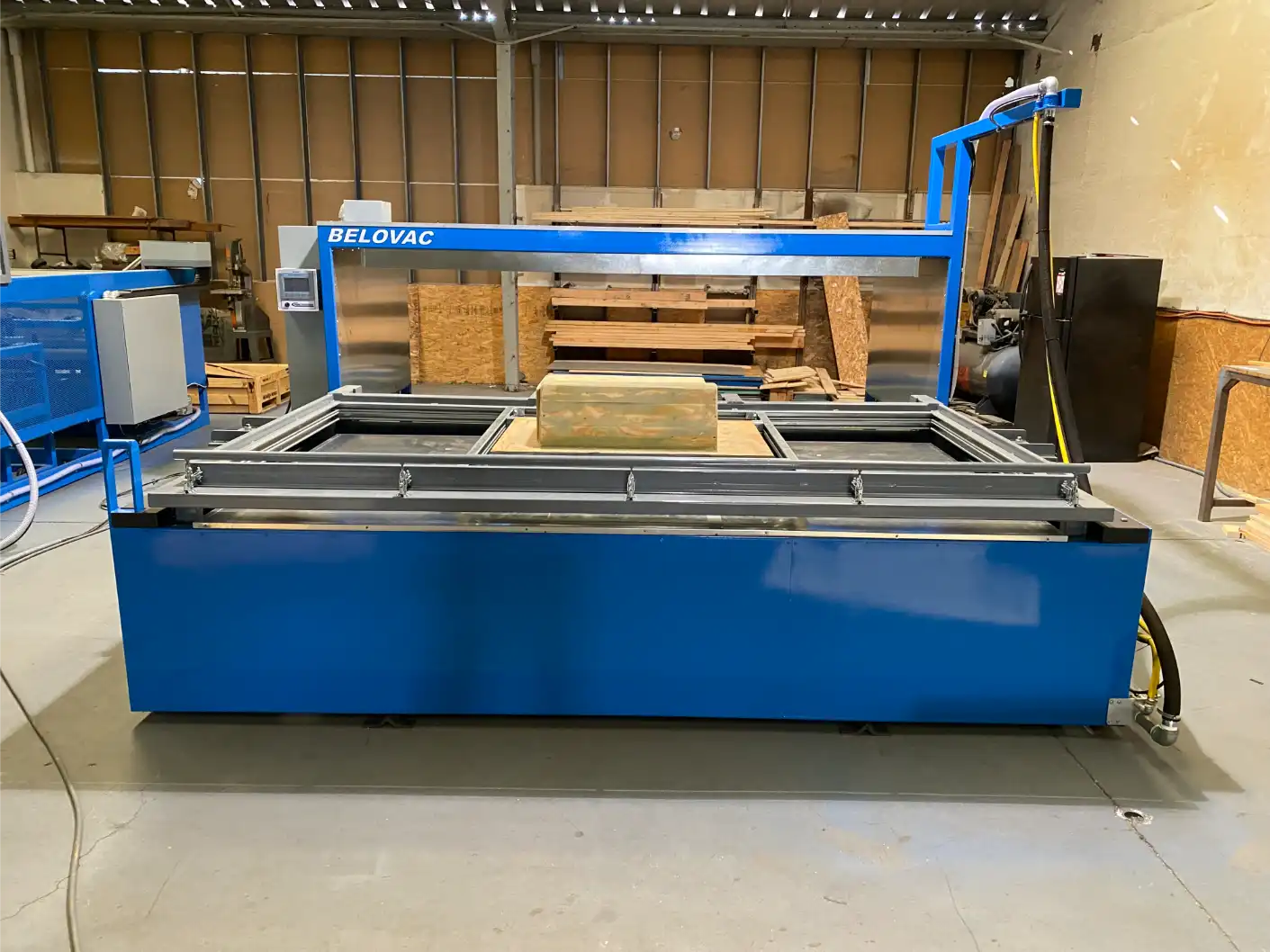
Companies that shift to an inline thermoformer often experience: Belovac’s large-format thermoforming machines are engineered to deliver the consistency and speed required for high-volume inline production operations.
- Reduced cycle times by up to 70%.
- Higher part-per-hour yields.
- Lower cost per unit due to volume efficiencies.
Consistent Quality Across High Volumes
Consistency is critical in high-volume production. Inline systems ensure uniform material heating and forming pressure across each part, reducing variability and waste. When equipped with zone-controlled ovens and programmable logic controllers (PLC), inline thermoformers deliver repeatable accuracy throughout long production runs.
This level of control supports industries where dimensional accuracy and surface finish are essential, such as:
Lower Labor Costs and Automation Integration
By automating multiple stages of the thermoforming process, inline systems reduce reliance on manual labor. Operators are required only for system setup, quality control, and occasional intervention. This opens opportunities for companies to reassign personnel to higher-value tasks while minimizing labor costs per part produced.
Modern inline thermoformers often support:
- Touchscreen interfaces for system control
- Automated trimming and stacking stations
- Data logging and performance diagnostics
Material Efficiency and Waste Reduction
Roll-fed inline thermoforming minimizes offcut waste compared to cut sheet methods. Excess material from trimmed areas can be collected and reprocessed, reducing raw material consumption. Systems with precision trimming reduce over-trim margins and maximize yield per roll of plastic.
| Aspect | Inline Thermoformer | Traditional Thermoformer |
|---|---|---|
| Material Feeding | Continuous roll-fed | Sheet-fed |
| Cycle Time | Faster with less downtime | Slower with manual loading |
| Labor Requirement | Low | High |
| Consistency | High | Variable |
| Waste | Minimal | Moderate to High |
Flexibility in Product Design
While inline systems are optimized for volume, they are not limited in flexibility. Many inline thermoformers can accommodate tool changes, material type variations, and custom mold depths. Advanced models support the forming of thick-gauge plastic for industrial applications as well as thin-gauge plastic for packaging lines.
Customization options include:
- Variable sheet widths and thicknesses
- Multi-zone oven controls
- Swappable forming tools
- Integrated robotic handling for post-processing
Ideal Applications for Inline Thermoforming
Inline thermoformer systems are widely used in industries that demand consistent quality and fast production turnaround. High-volume parts that benefit from thermoformed durability, low weight, and precision shaping are especially well-suited.
Common use cases include:
- Food and beverage containers
- Medical tray packaging
- Automotive components
- Consumer electronics housings
- Retail product clamshells
- Hot tub and spa shells
Energy Efficiency and Operational Cost Savings
Inline systems are designed to reduce energy consumption by reusing heat and maintaining efficient airflow in enclosed ovens. Programmable temperature zones allow heating only where necessary, cutting down on power use. This translates into long-term savings and lower environmental impact.
Additional cost-saving features often include:
- Energy-efficient IR or quartz heaters
- Heat recovery systems
- Integrated cooling units to reduce cycle time
Scalable Systems That Grow With Production
Inline thermoformer systems are modular and easy to expand. You can start with a basic setup and add new components as demand increases. This makes it easier to manage costs while meeting production goals.
Research on thermoforming processes highlights the benefits of modular heating and forming units for consistent output. Industry reports from Packaging Digest show how automation modules can be added to existing lines without halting production. Studies in Plastics Technology confirm that collaborative robots for trimming enhance productivity and cut cycle times.
- Modular layout: Expand forming lines without full system replacement.
- Efficient scaling: Add capabilities as needed.
- Lower risk: Spread out capital investment.
These scalable systems support long-term growth while keeping operations flexible and cost-effective.
Why Manufacturers Trust Belovac
Belovac has over 30 years of experience engineering custom thermoforming machines for demanding industrial applications. Their lineup includes inline roll-fed thermoformers built to handle high-volume production with precision and repeatability. Whether forming large parts like spa liners or producing thousands of smaller items daily, Belovac offers systems that combine flexibility with performance.
Manufacturers working with Belovac gain access to:
- Made-in-the-USA engineering and craftsmanship.
- Modular machines customized for specific industries.
- Manual, semi-automatic, and fully automated options.
- Expert guidance in selecting forming technology.
- Support for thick and thin gauge plastic forming.
Belovac’s inline thermoformer systems are designed for long-term productivity, helping companies reduce operating costs and meet tight production schedules. With capabilities extending from entry-level solutions to high-throughput lines, Belovac supports manufacturers seeking to modernize and scale efficiently.