
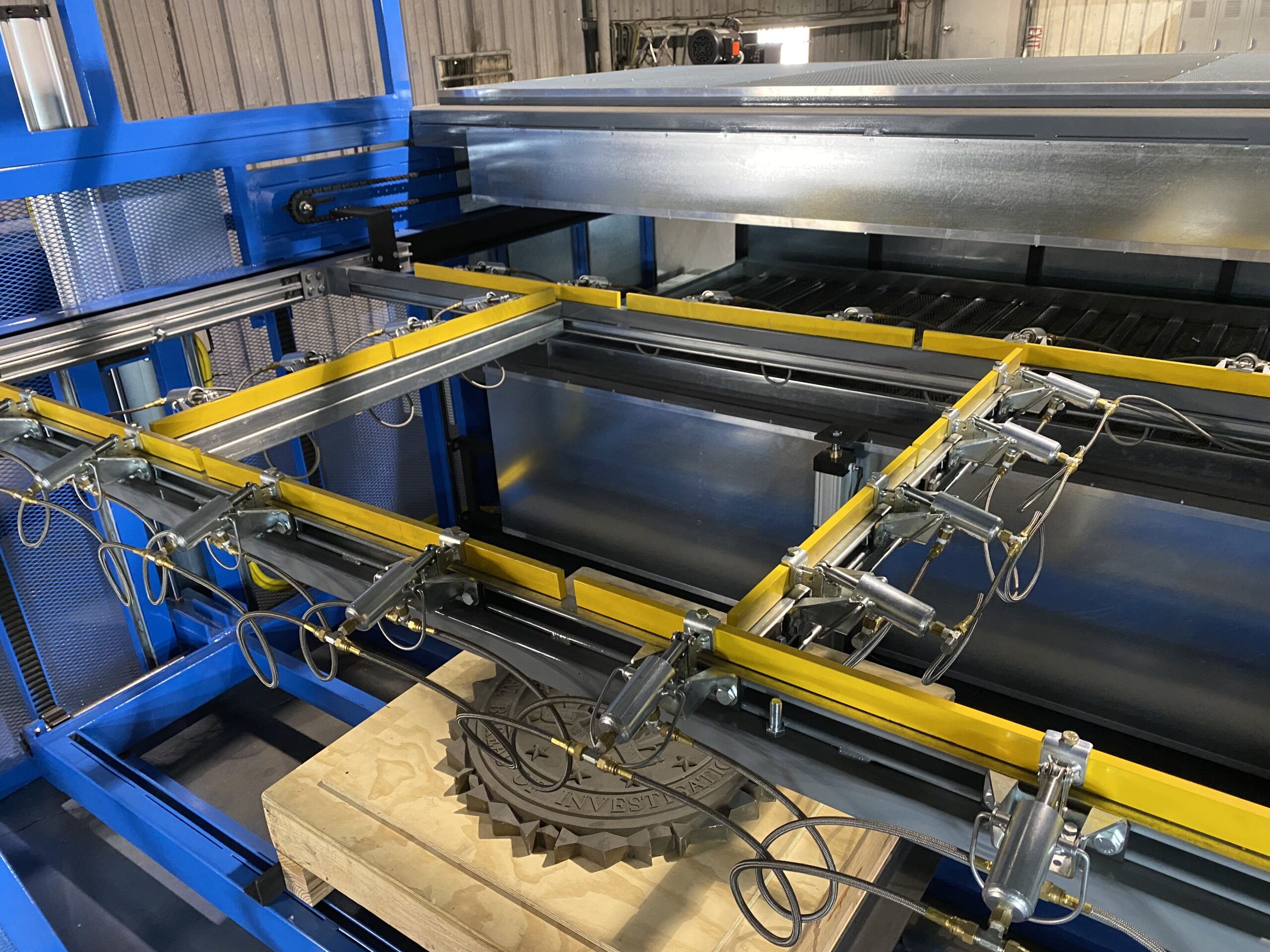
Thermoforming transforms a heated plastic sheet into a finished part by drawing it over a mold and trimming away excess material. The same core process supports very different outcomes depending on sheet thickness (gauge). Thin-gauge thermoforming excels at high-volume packaging and disposable items with fine detail at low cost. Heavy-gauge thermoforming produces durable, structural housings and covers with the look and performance of molded parts—without the tooling cost of injection molding. This guide clarifies how each approach works, where they shine, and how to factor in draw ratio and cycle time when you’re designing parts or choosing a manufacturing path.
At-a-Glance: Industries & Products by Gauge
| Industry | Typical Thin-Gauge Products (≈0.25–1.5 mm) | Typical Heavy-Gauge Products (≈2–12 mm) | Common Materials |
|---|---|---|---|
| Food & Beverage | Food trays, deli containers, lids, clamshells | Refrigerated display panels, vending fronts, kiosk cladding | Thin: PET, PS, PP | Heavy: ABS, PETG, PC/ABS |
| Medical & Life Sciences | Sterile blister packs, instrument trays, lids | Device housings, diagnostic cart panels, covers | Thin: PETG, HIPS | Heavy: ABS, Kydex®, PC, PVC-Acrylic |
| Consumer Goods & Retail | Retail blisters, insert trays, point-of-purchase trays | POP fascias, kiosk skins, fixture panels, signage | Thin: PET, PVC | Heavy: ABS, HIPS, Acrylic |
| Automotive, Truck, RV, Marine | Protective inserts, small trim liners | Dash panels, seat backs, wheel arch liners, engine covers | Heavy: TPO, ABS, PC/ABS, HDPE |
| Industrial & Equipment | Component trays, WIP handling trays | Machine enclosures, safety guards, shrouds, panels | Thin: HIPS, PP | Heavy: ABS, HDPE, TPO, FR grades |
| Aerospace & Transit | Protective packaging, catering trays | Interior trims, bulkhead panels, window reveals | Heavy: PC, PMMA/ABS, FR ABS |
What Counts as “Thin” vs “Heavy” Gauge?
Thin-gauge thermoforming typically uses roll-fed sheet around ≈0.25–1.5 mm (≈0.010–0.060 in.). It runs on high-speed, inline equipment where heating, forming, and trimming happen continuously—ideal for large volumes and low unit cost.
Heavy-gauge thermoforming uses cut-sheet stock around ≈2–12 mm (≈0.080–0.500 in.). Parts are formed on robust machines, then CNC-trimmed and finished. For mid-volume production, heavy-gauge achieves the look of molded parts with dramatically lower tooling cost and faster launch compared to injection molding.
Thin-Gauge Thermoforming: Where It Excels
Typical Use Cases
- High-volume packaging: blisters, clamshells, food trays, lids, cups
- Medical packaging: sterile trays and covers for instruments
- Consumer packaging and organizer inserts
Production Traits
- Throughput: Very fast; inline cycles are commonly single-digit seconds per index depending on part size and polymer.
- Detail & Finish: Excellent surface replication and crisp logos/branding.
- Cost Profile: Low part cost at scale; tooling is modest vs injection molds.
Design Notes
- Draw ratio is typically modest (shallow draws) to keep wall thinning controlled without complex assists.
- Materials: PET, PETG, PS/HIPS, PP dominate for clarity, stiffness, or cost.
- Trimming: In-line steel rule dies or matched-metal trim stations remove webs and frames.
Heavy-Gauge Thermoforming: Where It Excels
Typical Use Cases
- Structural covers and enclosures for machines and medical devices
- Automotive, truck, RV, and marine interiors and exterior trims
- Durable panels for kiosks, fixtures, and architectural features
- Twin-sheet parts (two heated sheets formed and fused) for hollow, stiff, or insulated components such as ducts and pallets
Production Traits
- Throughput: Cut-sheet cycles commonly range from ~45–180+ seconds depending on thickness, tool mass, and cooling.
- Part Quality: High stiffness and impact resistance; paint- or film-capable surfaces; color-through aesthetics.
- Post-Processing: CNC trimming, drilling, bonding, inserts, gasketing, EMI shielding as needed.
Design Notes
- Draw ratio can be higher than thin-gauge but must be managed to avoid thinning at corners and deep walls.
- Materials: ABS, PC/ABS, TPO, HDPE, Kydex®, FR grades for performance, chemical resistance, and regulatory compliance.
- Appearance: Texture tools and cap sheets can deliver molded-in grain or gloss without painting.
Understanding Draw Ratio (and How It Sets Starting Gauge)
Draw ratio (DR) expresses how much the sheet stretches to cover the mold. A simple way to estimate it is by comparing the mold’s total surface area to the sheet’s footprint over the mold cavity.
Draw Ratio (DR) ≈ Mold Surface Area ÷ Sheet Footprint
Starting Gauge ≈ DR × Desired Finished Wall
Why it matters: As DR increases, localized wall thinning increases—especially at corners and along deep walls. To preserve target wall thickness, you’ll either raise the starting gauge or reduce thinning through design and process controls.
Practical Guidelines
- Target DR: Many parts work well below ~2:1. Ratios approaching ~3:1 require careful design, radii, and process aids; beyond that, consider plug-assist, material changes, or geometry adjustments.
- Use generous radii and fillets: Sharp inside corners thin aggressively. Larger radii distribute strain more evenly.
- Provide draft: 3–5° on male molds and 1–3° on female molds is a common starting point to aid release and limit scuffing.
- Add plug-assist for deep draws: A properly designed plug pre-stretches the sheet to maintain more uniform wall thickness at the base and corners.
- Consider twin-sheet for stiffness or hollows: Two formed sheets fused together achieve deep shapes and internal channels with more uniform walls than an extreme single-sheet draw.
Cycle Time: The Hidden Driver of Cost
Cycle time is the total time to heat, form, cool, trim, and eject a part. It drives hourly output and affects part cost even more than raw material in many programs.
What Extends or Reduces Cycle Time?
- Thickness: Thicker sheets take longer to heat through and cool. Moving from 3 mm to 6 mm can more than double heat/cool time if oven and mold cooling aren’t optimized.
- Polymer & color: Semi-crystalline materials (HDPE, PP) typically need more energy than amorphous (ABS, HIPS). Dark colors often heat faster than light/white.
- Part size & tool mass: Large envelopes and heavy tools store heat; efficient cooling channels and temperature control are essential.
- Automation: Shuttle/rotary machines, auto-sheet loaders, and robotic offload/CNC integration reduce handling time and variability.
- Forming method: Pressure forming and twin-sheet can add seconds but deliver better definition or structure—often worth the tradeoff.
Typical Ranges
- Thin-gauge inline: ~3–10 seconds per index (multiple cavities per cycle).
- Heavy-gauge cut-sheet: ~45–180+ seconds per cycle depending on thickness, size, and cooling strategy.
- Twin-sheet heavy-gauge: Often longer than single-sheet by 50–100% due to heating two sheets and fusing.
How to Choose: A Simple Decision Framework
If You Need Millions of Units at the Lowest Unit Cost
Choose thin-gauge. Inline forming, quick cycles, and roll-stock pricing make it unbeatable for high-volume packaging. Design with modest draw ratios, add draft, and prioritize denesting features for automated stacking.
If You Need Durable, Aesthetic Housings and Panels
Choose heavy-gauge. For hundreds to low-thousands of parts per year, it replaces injection-molded housings with far lower tooling cost and faster time to market. Use textured tools, cap sheets, or paint when specific finishes are required. Plan for CNC trimming and hardware installation.
If You Need Stiff, Hollow Shapes or Integrated Channels
Consider twin-sheet heavy-gauge. It achieves “boxy” stiffness with uniform walls and can include internal passages for airflow, wiring, or insulation.
Design for Success: Tips That Pay Off
- Start with the finished wall in mind: Estimate draw ratio early and back-solve starting gauge. Validate with prototypes.
- Tune geometry for flow: Add radii, avoid knife-edge features, balance wall lengths, and use ribs only where needed to avoid sink and print-through.
- Align material and environment: Select resins for impact, temperature, chemicals, UV, and flammability ratings required by your market.
- Plan the trim: Define trim lines and mounting features early so fixtures and CNC programs can be developed alongside forming tools.
- Measure and iterate: Use thickness mapping to verify wall distribution; adjust heat profiles, plug geometry, or vents to fine-tune results.
Whether you’re launching a sterile tray, a retail display fascia, or a rugged machine cover, understanding gauge, draw ratio, and cycle time helps you choose the right thermoforming path—and hit your cost, quality, and lead-time targets with confidence.