
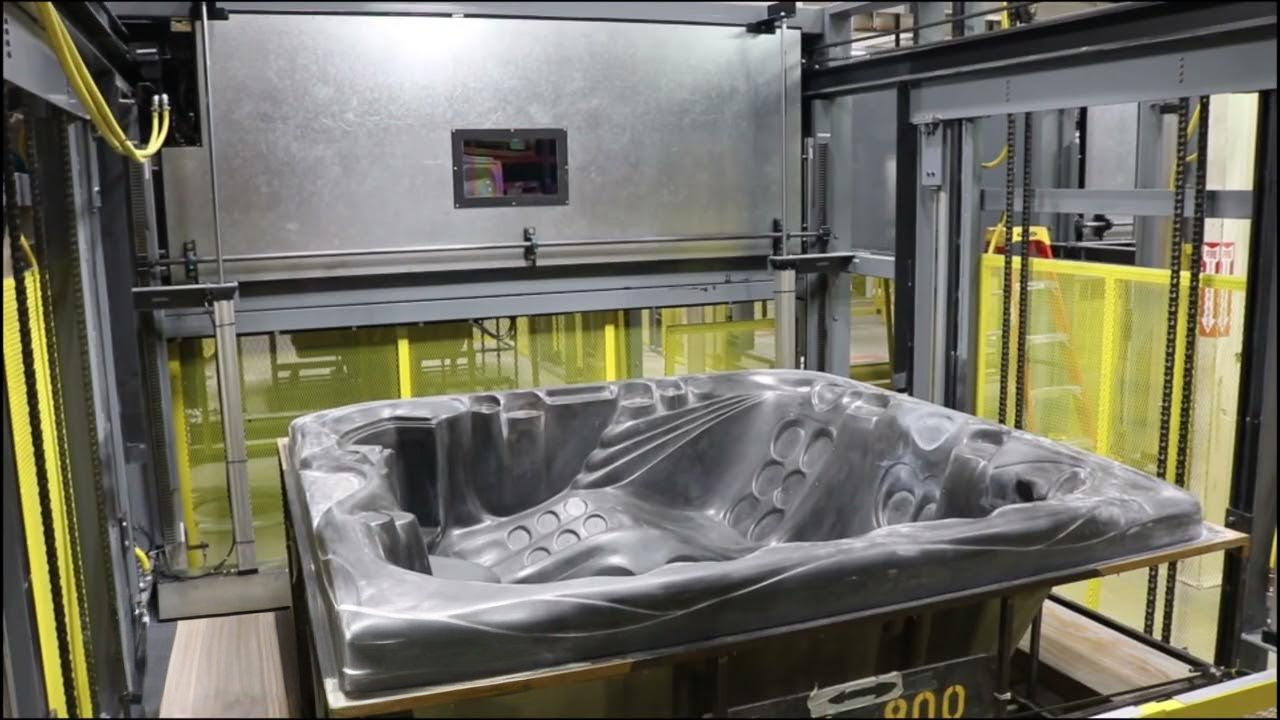
Growing demand for premium spas and hot tub production pushes manufacturers to produce hot tubs that balance strength, design, and efficiency. Achieving these standards relies on precise thermoforming processes and dependable equipment. Vacuum forming remains the leading method for shaping acrylic shells into durable, contoured structures with uniform thickness. High-performance industrial vacuum forming machines enable consistent quality and long-term reliability in large-scale production.
Precision Mold Engineering and Material Compatibility
The foundation of a successful hot tub forming process begins with precise mold design and proper material selection. Molds act as the link between concept and finished product, determining both dimensional accuracy and surface quality. Advanced mold fabrication methods, such as CNC machining of aluminum or high-density composites, ensure consistent performance across production runs and maintain stable thermal conductivity during repeated heating cycles.
Attention to surface finish, venting channels, and uniform heat distribution allows each sheet to form cleanly without air entrapment or surface distortion. Engineers should integrate strategically placed vacuum ports and smooth radius transitions to promote steady airflow and efficient forming.
Material choice has a direct impact on heating behavior and final part strength. Most manufacturers use acrylic or ABS-acrylic composite sheets because of their strength, gloss retention, and UV stability. Before forming, these materials must be carefully conditioned. Residual moisture can cause bubbles or hazing when exposed to heat. Many facilities rely on an industrial drying oven to stabilize temperature and eliminate trapped moisture before loading the material onto the forming station. Belovac’s large-format vacuum forming machines provide the precise temperature control and consistent performance necessary for high-quality hot tub production.
Thermal Management and Controlled Heating Techniques
Consistent heating is essential for maintaining wall thickness and achieving uniform material distribution during hot tub forming. Excessive heat causes sagging and surface stress, while insufficient heat reduces draw depth and mold accuracy. To maintain precision, manufacturers use segmented heating zones with calibrated infrared elements that provide independent control across the sheet surface.
Advanced forming equipment, such as the BV E-Class vacuum forming machine, incorporates PID-controlled temperature zones to ensure each area reaches optimal forming temperature simultaneously. This precise control allows the plastic to stretch smoothly over complex contours such as seats, steps, and foot wells.
For deeper or oversized spa molds, staged heating cycles help reduce thermal stress and improve surface uniformity. Many facilities also integrate high-speed inline roll-fed systems that automate temperature regulation and sheet alignment, increasing forming accuracy and throughput in continuous production lines.
Vacuum Distribution and Forming Efficiency
After a sheet reaches its forming temperature, precise vacuum control becomes critical to product consistency and surface definition. A well-engineered vacuum system distributes uniform suction across the mold, preventing trapped air and uneven material stretch. Many manufacturers design multi-zone vacuum networks to regulate suction strength in deep or complex contours.
In large spa molds, rapid vacuum engagement within milliseconds of sheet contact helps preserve surface gloss and eliminate cooling marks. Automated forming lines synchronize vacuum timing with plug assist or mold closure movements, ensuring the forming window remains ideal for accurate detail replication.
Modern PLC-controlled vacuum forming machines use programmable logic to automate timing, pressure levels, and cooling sequences. Systems such as the BV A-Class full-auto vacuum former enable operators to store forming parameters for multiple hot tub designs, reducing setup time while improving repeatability and production consistency.
Cooling Management and Mold Release Optimization
Cooling is one of the most critical yet frequently underestimated stages of the vacuum forming process. The rate and method of cooling determine dimensional accuracy, internal stress balance, and final surface quality. Uneven cooling can result in warping or cracking during demolding, especially in deep-draw applications. Controlled air or mist cooling systems help standardize this phase, ensuring uniform solidification across the shell’s entire surface.
Maintaining vacuum pressure throughout the initial cooling period prevents deformation and limits shrinkage. Many facilities use integrated mold cooling channels or air knives to accelerate cycle times while preserving the structural integrity of the part. Efficient cooling management can reduce total production time by up to 20 percent, increasing daily output without sacrificing product quality.
To enhance throughput, manufacturers often use dual-station vacuum forming systems that allow one mold to cool while another begins heating. This alternating setup minimizes downtime, stabilizes production flow, and supports high-volume operations in spa and hot tub manufacturing.
Process Automation and Data-Driven Control
Automation continues to redefine hot tub manufacturing by improving precision, consistency, and overall productivity. Reducing manual intervention allows producers to achieve tighter process control and repeatable results, even in demanding production schedules. Automated forming systems now handle every stage of the workflow, including sheet loading, forming, trimming, and stacking, ensuring uniform quality across high-volume operations.
Modern equipment integrates digital control interfaces that let operators monitor temperature distribution, vacuum pressure, and cycle timing in real time. These systems detect irregularities early and prevent defects before they affect a full production run. Facilities using PLC-controlled forming systems benefit from integrated data acquisition, allowing performance comparison, trend analysis, and precise machine parameter adjustments based on environmental conditions.
In large-scale facilities, robotic trimming systems are often paired with large-format vacuum forming machines to streamline post-forming processes. This combination reduces labor costs, maintains tight dimensional tolerances, and ensures consistent edge geometry, which is vital for accurate hot tub assembly and watertight sealing.
Preventive Maintenance and Equipment Longevity
Preventive maintenance remains a defining aspect of reliable hot tub manufacturing. Vacuum forming systems that operate continuously under high temperatures and pressure differentials require regular calibration and cleaning. Common maintenance tasks include vacuum pump inspection, seal replacement, and infrared heater recalibration.
Neglecting these checks can lead to vacuum leaks, uneven heating, or slower cycle times, which directly impact production efficiency. Regular calibration ensures thermal sensors remain accurate and prevents overuse of energy. Following manufacturer maintenance schedules significantly extends equipment lifespan and safeguards consistency across thousands of production cycles.
Some manufacturers adopt predictive maintenance strategies using process data logs from their vacuum forming machine monitoring systems. By tracking vacuum timing, heater response, and motor performance, operators can anticipate potential issues and perform maintenance before breakdowns occur.
Material Handling and Workflow Optimization
Streamlined material handling directly influences product quality, consistency, and operational safety. Acrylic and ABS sheets are particularly vulnerable to surface contamination, scratches, and static buildup, all of which can affect visual clarity and finish. Maintaining controlled conditions in the loading zone and using antistatic handling tools minimizes dust adhesion and surface defects.
Automation enhances precision and reduces handling damage. Systems equipped with automated sheet feeders, conveyors, and alignment sensors maintain consistent positioning and reduce operator-dependent variation. This approach supports continuous forming operations while minimizing downtime between cycles.
Integrating handling automation with forming and trimming processes boosts throughput and improves traceability. Facilities implementing inline roll-fed vacuum forming systems gain better production flow and reduced floor congestion. When combined with automated labeling or barcode tracking, manufacturers can simplify batch management and strengthen quality assurance across production runs.
Quality Assurance and Inspection Technology
Consistent quality is a hallmark of modern hot tub manufacturing. Quality assurance processes should begin at the raw material stage and continue through every production step. Thickness mapping tools measure wall uniformity, while thermal imaging cameras help validate heater calibration. Dimensional scanning ensures molds and finished shells meet engineering tolerances.
In addition, some manufacturers integrate non-contact laser inspection into their thermoforming setups to verify shape and contour accuracy. This proactive approach minimizes waste, rework, and customer warranty claims while ensuring each shell fits precisely during final assembly.
Energy Efficiency and Environmental Responsibility
Sustainability in manufacturing is becoming increasingly important, and vacuum forming operations are no exception. Energy-efficient heating systems and smart control technology help minimize energy use per cycle. Closed-loop vacuum systems recycle air efficiently, while modular insulation around heaters prevents energy loss.
Waste reduction initiatives such as trimming optimization and scrap recycling further enhance environmental performance. Many modern facilities now integrate scrap recovery systems that regrind excess material into usable sheet feedstock, aligning with broader sustainability objectives while cutting material costs.
Equipment Purpose-Built for Spa Shell Manufacturing
Manufacturers sourcing equipment specifically engineered for deep-draw spa and hot tub shells can review Belovac’s spa and hot tub forming machines, built with the thermal control and clamping capacity needed for consistent shell production.
How Belovac Supports the Future of Hot Tub Manufacturing
Belovac provides advanced vacuum forming systems engineered to help hot tub manufacturers achieve precision, consistency, and production efficiency. With decades of thermoforming experience, our equipment combines strength, automation, and reliability to improve every stage of fabrication from sheet drying to forming and cooling. Belovac offers:
- Spa forming machines built for deep-draw acrylic and ABS shells.
- PLC-controlled systems that increase repeatability and reduce manual labor.
- Large-format vacuum formers for oversized spa molds and consistent thermal control.
- Energy-efficient drying ovens that enhance surface quality and clarity.
- Dual-station units that support simultaneous heating and cooling cycles.
Each Belovac system meets rigorous performance and compliance standards to ensure long-term reliability and consistent output in high-volume production.
To enhance your manufacturing capability with precision-engineered forming technology, request a quote or contact the Belovac team today.