
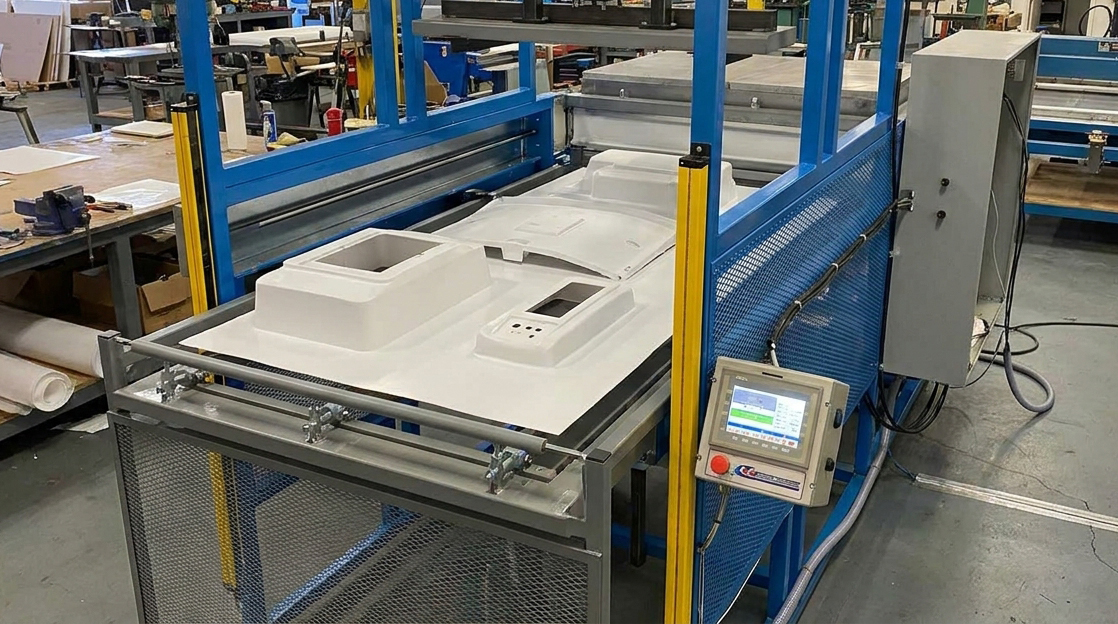
Electronics and appliance enclosures are among the most consistent applications in vacuum forming production. Outer shells for desktop equipment, instrument housings, control panels, kiosk enclosures, and appliance panels share common design requirements, similar material profiles, and production volumes that consistently favor vacuum forming tooling cost over injection molding.
The process has produced these parts across industrial, commercial, and consumer sectors for decades. What continues to change is the range of materials available, the surface finish achievable from modern tooling, and the scale of panels that large-format equipment can produce in a single forming cycle.
Where Vacuum Forming Fits in Electronics Manufacturing
Vacuum forming produces the outer shells and enclosures of electronics and appliance products, not the internal components. The process is suited for large or moderately sized flat and contoured panels, rear covers, equipment surrounds, kiosk frames, and housings where the structural requirement is cosmetic and protective rather than precision-mechanical.
Typical applications include rear covers for monitors and displays, outer housings for desktop printers and office equipment, control panel surrounds and instrument enclosures, point-of-sale terminal housings, outer shells for medical equipment and diagnostic devices, and the outer panels of large commercial appliances. The common thread across these is medium to large part size, moderate annual volume, and a surface finish requirement on at least one side of the part.
What vacuum forming cannot do is produce tight-tolerance mechanical features, internal undercuts without split tooling, or part geometries that require uniform wall thickness throughout. Parts with those requirements belong in injection molding. But for parts where large panel area, cost-effective tooling, and medium production volume are the primary variables, vacuum forming consistently delivers.
Material Selection for Electronics and Appliance Housings
ABS is the dominant material for electronics and appliance enclosures. Its combination of impact resistance, paintability, surface finish quality from textured mold surfaces, and wide availability in standard gauges makes it the default selection for most consumer and commercial electronics housings. UL94 flame-rated grades of ABS are available for products requiring flammability certification, which covers most consumer electronics sold in North American markets.
HIPS is used where lower structural demands allow cost savings to justify the reduced impact resistance and surface quality. Internal shields, non-visible structural panels, and lower-tier enclosures where mechanical performance is limited are appropriate HIPS applications within electronics manufacturing.
ASA offers a UV-stable alternative to ABS for outdoor electronics enclosures, communications equipment housings, and any enclosure with prolonged sun exposure in service. Its forming behavior is similar to ABS, allowing most operations to process ASA without significant machine adjustment. For a detailed comparison of thermoplastic options, the vacuum forming material selection guide covers key properties across the full range of common sheet materials. The Society of Plastics Engineers also maintains technical resources on UL-rated engineering thermoplastics used in electrical and electronic enclosure applications.
Surface Finish Standards for Visible Consumer Housings
Consumer electronics and appliance enclosures carry a visible surface requirement that most other vacuum forming applications don’t face. The exterior surface of a monitor rear cover, printer housing, or medical device shell is evaluated by the end user. Surface quality at this standard requires attention at both the material and mold levels.
Mold surface finish transfers directly to part surface finish in vacuum forming. A polished mold produces a higher-gloss part. A textured mold produces grained or matte finish that masks minor surface variation and reduces visible fingerprints. Fine-grain textures are common for consumer electronics applications and are achievable through standard mold surface treatment.
ABS produces more consistent reproduction of fine texture from mold surfaces than HIPS, particularly at tight grain patterns. For visible, appearance-critical enclosures, this difference in base surface quality factors into material selection before any post-forming finishing operation is considered. Paint or applied film can achieve specific appearance targets from either base material, but a better base surface reduces the finishing cost per part.
Design Rules That Affect Production Quality
Vacuum formed enclosures have design constraints that differ from injection molded parts. Designing to those constraints from the start produces better parts at lower tooling and production cost than trying to compensate during process setup.
- Draft angles are required on all vertical surfaces for clean part release. A minimum of one degree per side is typical, with more for deeper draws or surfaces with fine texture
- Corner radii must be sized to avoid excessive material thinning. Tighter radii require more stretch, which reduces wall thickness at those locations
- Wall thickness will vary across the formed part. The structural design must account for minimum thickness at the thinnest location, not the nominal sheet gauge
- Internal undercuts require split tooling or post-forming assembly. Parts with significant undercut requirements may need design modification to work within vacuum forming process limits
Electronics enclosures designed with these constraints in mind form consistently, release cleanly, and don’t require process adjustments to hit dimensional requirements from run to run.
Production Volume and the Tooling Decision
Vacuum forming tooling cost for electronics enclosures is significantly lower than injection molding tooling at equivalent part size. An aluminum vacuum forming tool for a mid-size equipment housing represents a fraction of the cost of equivalent injection mold tooling. That gap makes vacuum forming the economically logical choice across a wide production volume range.
The crossover point where injection molding’s lower per-part cost justifies the tooling investment varies by part complexity, size, and annual volume. For production volumes in the range of hundreds to several thousand parts per year, and for any part large enough that injection mold tooling becomes very expensive, vacuum forming delivers better total production economics. Understanding where your specific application sits in that range shapes the tooling and equipment decision considerably.
Belovac Equipment for Electronics and Appliance Enclosure Production
Belovac manufactures vacuum forming equipment across the full range of enclosure production requirements. Mid-format sheet-fed machines in the E-Class series handle most instrument housings, control panels, and equipment enclosures in the commercial and industrial electronics space. Larger format configurations address the biggest single-piece panels in commercial appliance and display enclosure production.
The machine comparison page helps match forming area and configuration to the specific part size and volume requirements of an enclosure application. The industries served section provides additional context on how Belovac equipment maps to commercial and industrial production environments. If you’re evaluating equipment for electronics or appliance enclosure production, request a quote and Belovac’s team can help identify the right machine configuration for your application.