
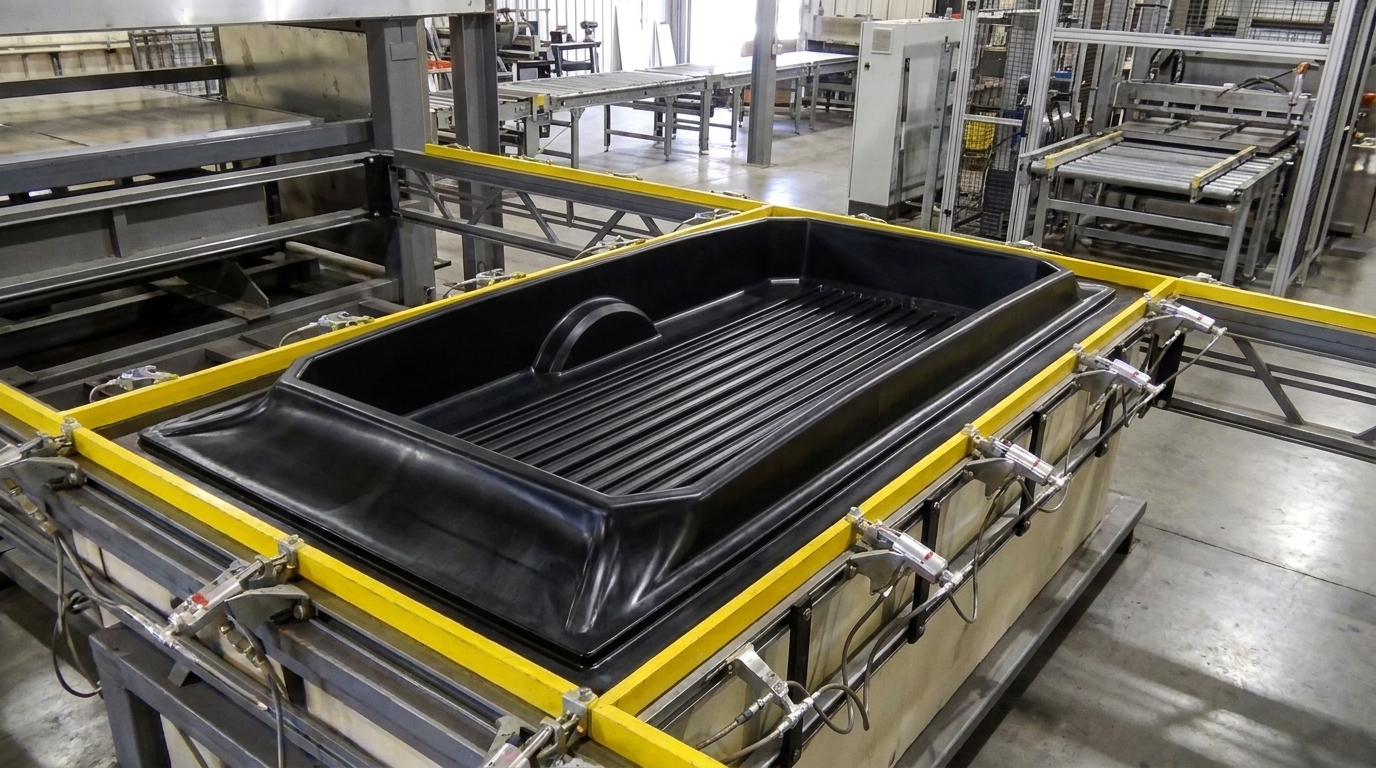
An RV wall panel or compartment liner doesn’t crack or delaminate because the sheet stock was wrong. It fails because the machine forming it couldn’t hold even heat and consistent vacuum across a large, contoured panel. The part looks fine coming off the mold, then shows print-through, thin corners, or stress cracking once it’s riding down the highway and cycling through heat and vibration.
Why RV Panels Are a Different Forming Problem
RV components aren’t one shape. Wall panels are wide and mostly flat, ceiling panels carry long, shallow contours for lighting and vent cutouts, and compartment panels need tighter corner definition to seal against doors and latches. A machine sized for a single part type struggles the moment a shop’s production mix shifts to the next panel style.
Large flat and low-contour panels are deceptively hard to form well. Without full-width heater evenness, the sheet cools unevenly as it’s pulled across a wide platen, leaving warped panels that won’t sit flush against framing. Compartment panels with molded-in ribs, latch pockets, or vent housings need sustained vacuum to fully seat detail without thinning the panel face, and undersized vacuum systems leave webbing or soft spots exactly where structural strength matters most.
Why the Fix Is Machine Capacity, Not Technique
Shops get blamed for warped panels or inconsistent wall thickness that are really an equipment limitation. No amount of adjusting cycle time compensates for a machine that doesn’t have the heater zone control or sheet capacity RV panels require. Wall panels, ceiling panels, compartment liners, and wheel well covers all share the same demand: even heat and reliable vacuum across large sheet sizes and varied contours, not just one part geometry. Our custom large-format machines are configured around the sheet sizes and draw depths a shop’s full RV panel lineup actually requires, rather than being sized around a single component.
What Actually Separates a Capable Machine From an Underpowered One
Spec sheets make most vacuum forming machines look interchangeable. The gap shows up once a shop is running full production runs across multiple panel types, not a single demo part.
| What to check | Why it matters for RV panels |
|---|---|
| Sheet size and platen capacity | Wall and ceiling panels often run large and near-flat; undersized platens force seams or multiple pours per panel |
| Independent heater zones | Panels vary from flat to lightly contoured across a run; uneven zone control leaves warped or wavy sections |
| Vacuum draw and hold time | Compartment panels with ribs and latch pockets need sustained pull to fully seat detail without thinning the face |
| Mold changeover speed | RV production runs multiple panel types per unit; slow tooling swaps stall throughput across a build schedule |
| Material handling for large sheets | Wide, thin panels are prone to sagging or scratching during loading, which shows up as visible defects on finished walls |
Buyers who choose on price alone tend to find these gaps after the first full production run, when panels come out warped or inconsistent and the only fix is running well below the machine’s rated capacity.
Automation Matters as Much as Raw Capacity
A shop building a handful of custom coaches a year has different needs than one running repeat panel production across multiple RV lines. PLC-controlled, multi-zone systems hold tighter tolerances run after run and reduce the operator judgment calls that lead to inconsistent panels across a production batch.
Matching Machine Size to Your Full Production Mix
Few RV manufacturers form only one panel type. Most run wall panels, ceiling panels, compartment liners, and exterior components through the same equipment, which means the right machine isn’t sized around one part, it’s sized around the full range of sheet sizes and contours moving through the shop. Belovac has built thermoforming equipment in Banning, California since 1984, and financing through Univest Capital is available for shops weighing a large-format purchase against the ongoing cost of scrap and rework on undersized equipment.
Choosing the Right Machine Comes Down to the Panel You’re Actually Forming
Every RV manufacturer evaluating equipment is answering the same question: does this machine have the sheet capacity, zone control, and vacuum strength the panel lineup requires, or will every run be a fight against the equipment’s limits. That’s an engineering match between panel geometry and machine capability, not a spec sheet comparison.
Request a Quote and we’ll help you confirm the right machine for your panel sizes and production volume before you commit to equipment.