
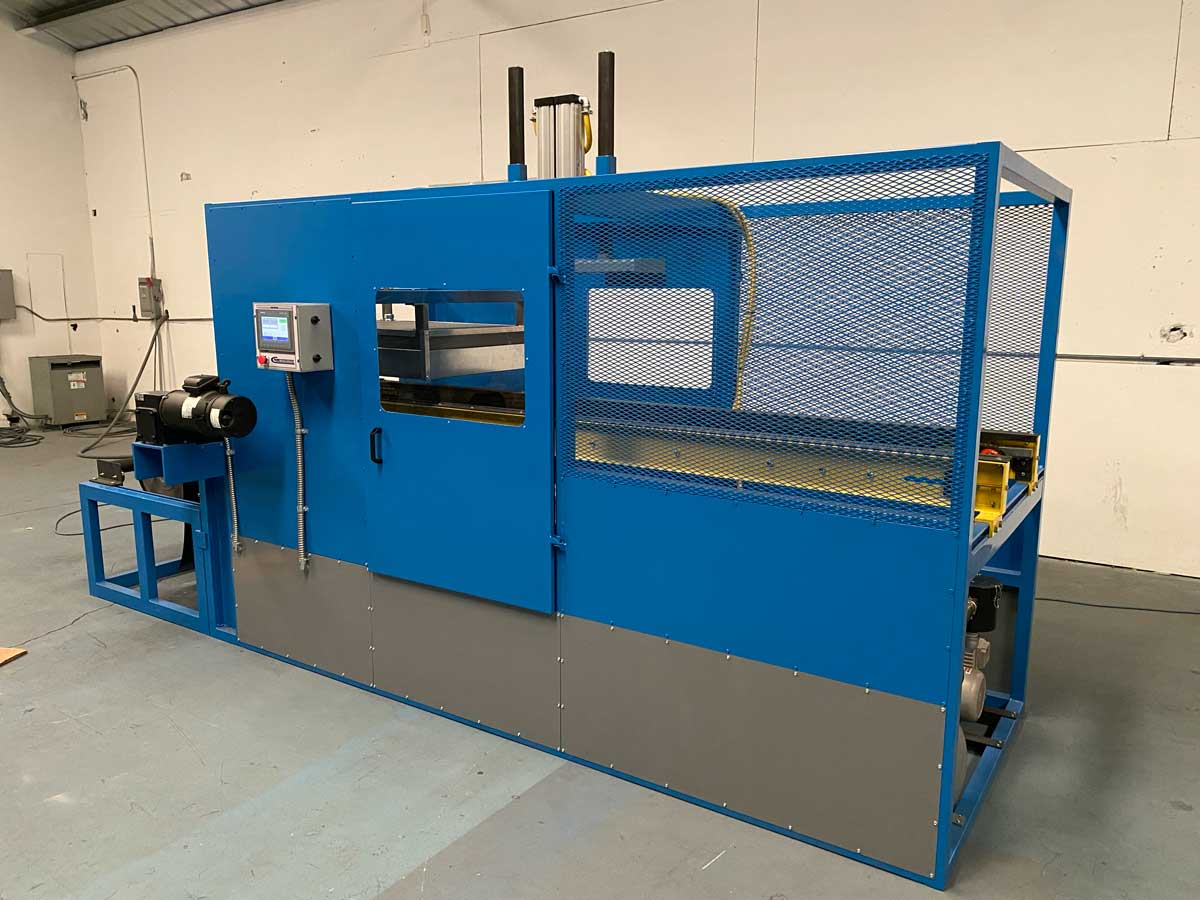
Buying, running, and maintaining a vacuum forming machine involves dozens of decisions that rarely get made all at once. Sheet size and draw depth come first. Then heater type, vacuum capacity, mold venting, trimming method, and how much of the cycle should be automated. Each choice narrows the next one, and getting one wrong early tends to show up later as thin corners, webbing, or a cycle time that never quite hits the number the quote was built on.
This page collects everything Belovac has published on vacuum forming equipment into one place, organized by the order those decisions usually get made. Whether you are specifying a first machine, replacing aging equipment, or troubleshooting parts coming off a machine you already own, the guides below cover the mechanical and process fundamentals behind each stage. For broader industry context and technical standards work, the SPE Thermoforming Division maintains research and conference material worth following alongside equipment-level resources.
What Does a Vacuum Forming Machine Actually Have to Get Right?
Vacuum forming looks straightforward on a process diagram. A thermoplastic sheet is clamped, heated until pliable, drawn over a mold by vacuum pressure, then cooled and trimmed. The complexity lives in the tolerances. Heat has to arrive evenly across the entire sheet, not just at the center. Vacuum has to reach full draw before the sheet cools past its forming window. The mold has to breathe through vents small enough not to mark the part. Cooling has to be uniform or the part warps as it releases internal stress.
If you want the process laid out step by step before working through equipment specifics, start with the vacuum forming diagram and visual guide, which walks through each stage of the cycle and what happens mechanically at every point.
How Do You Match a Machine to the Parts You Are Forming?
Machine selection starts with the largest part you plan to run, not the average one. Forming area, draw depth, and sheet gauge together define the envelope, and pushing past that envelope is where most equipment problems begin. Beyond the envelope, the next question is production format. Sheet-fed operation suits thicker gauge, lower volume, and frequent changeovers. Roll-fed inline operation suits thin gauge running at high volume with minimal operator involvement.
These guides cover the selection decisions in the order they usually come up:
- How to choose a vacuum forming machine, covering forming area, draw depth, gauge range, and the specification questions to answer before requesting quotes.
- Single station versus dual station vacuum forming, and how the second station changes cycle time, floor space, and operator workload.
- Inline roll-fed versus sheet-fed thermoforming, comparing the two production formats across volume, gauge, and changeover flexibility.
- Pressure forming machines for thin gauge thermoforming, for applications where vacuum alone will not capture the detail the part requires.
- Industrial vacuum forming services, useful when the question is whether to buy equipment or outsource the work.
Which Plastics Work Best in Vacuum Forming?
Material selection and machine selection are the same conversation. A machine sized correctly for HIPS may struggle with the same part in polycarbonate, because the two materials have different forming windows, different heat absorption behavior, and very different tolerance for uneven heating. Sheet gauge compounds the issue. Thicker sheet holds heat longer but requires more energy to bring to temperature evenly, and thin gauge cools so fast that any delay reaching full vacuum shows up as an incomplete draw.
The best plastics for vacuum forming selection guide breaks down the common thermoplastics by forming temperature range, draw characteristics, surface finish, and typical application, along with the equipment implications for each.
How Much Does the Heating System Affect Part Quality?
More than most operators expect. The heating stage is where uniformity is either established or lost, and no amount of vacuum capacity compensates for a sheet that arrives at the mold with hot and cold zones. Heater technology determines how quickly heat arrives and how precisely it can be zoned. Quartz elements respond fast and suit frequent changeovers and shorter cycles. Ceramic elements hold heat longer and deliver steadier output on long production runs, at the cost of slower response when settings change.
Two resources cover this stage in detail. The quartz versus ceramic heaters comparison covers the element decision itself, while PLC controls for automated thermoforming machines explains how zone control turns a heater bank into a repeatable process rather than an operator judgment call.
How Do You Size a Vacuum Pump for Thermoforming?
Vacuum sizing gets treated as a spec sheet number when it is really a timing problem. What matters is not peak vacuum but how quickly the system reaches full draw, because the sheet is cooling the entire time. A pump that eventually pulls a strong vacuum but takes too long to get there produces the same defects as a pump that is simply undersized. Reservoir volume, line diameter, valve response, and mold venting all sit between the pump and the part.
Work through vacuum pump sizing for thermoforming for the calculation approach and the system components that affect draw speed alongside raw pump capacity.
What Mold Details Make the Biggest Difference?
Tooling is where good equipment either performs or gets blamed for problems it did not cause. Two mold-side variables account for a large share of surface defects and release issues. Vent placement controls whether air escapes fast enough and evenly enough for the sheet to seat fully into detail areas. Release chemistry controls whether the finished part comes off cleanly or drags, scuffs, and slows the cycle.
The vent hole placement guide for thermoforming molds covers hole sizing, spacing, and the geometry that dictates where vents belong. Mold release agents for vacuum forming covers the agent types, application methods, and the tradeoffs between release performance and surface finish or downstream printing.
What Happens After the Part Comes Off the Mold?
A formed part is not a finished part. Trim quality determines whether the component is production-ready or needs secondary handling, and the trimming method chosen affects tooling cost, cycle time, edge quality, and how much scrap gets generated per part. Router trimming, die cutting, and integrated inline trim stations each fit different volumes and part geometries.
The post-forming trimming methods guide compares the approaches and identifies which ones make sense at which production volumes.
When Is Automation Worth the Investment?
Automation is usually justified with labor math, but the stronger argument is consistency. An automated machine runs the same cycle every time, which removes the operator variability that shows up as inconsistent wall thickness across a shift. The tradeoff is flexibility. Highly automated lines reward long runs of the same part and penalize frequent changeovers.
This table summarizes where each level of automation tends to fit, based on the way production is actually structured rather than machine capability alone:
| Automation level | Best suited to | Main tradeoff |
|---|---|---|
| Manual sheet-fed | Prototyping, short runs, frequent part changes | Cycle consistency depends on operator |
| Semi-automatic with PLC control | Mixed production with repeat parts | Still requires loading and unloading labor |
| Fully automatic sheet-fed | Steady volume across a limited part family | Changeover time becomes a real cost |
| Inline roll-fed | High volume thin gauge, single part running continuously | Least flexible, highest capital commitment |
For a fuller treatment of what automation changes mechanically and operationally, see automatic thermoforming vacuum machines and automation.
Which Industries Have Specialized Equipment Requirements?
Some applications carry requirements that sit outside standard machine specification. Aerospace work brings material traceability, documented process control, and tighter dimensional expectations on large panels. Medical device and packaging work brings cleanroom considerations, validated repeatability, and material handling requirements that affect how the machine is configured and where it is installed.
Two guides cover these vertical requirements: aerospace vacuum forming and thermoforming machines, and medical device vacuum forming and packaging equipment.
What Should You Prepare Before the Machine Arrives?
Installation problems are almost always site problems, not equipment problems. Electrical service, compressed air supply, vacuum system placement, floor loading, clearance around the platen, and ventilation all need to be confirmed before delivery rather than discovered during commissioning. A machine that sits waiting on an electrician is a machine that is not producing parts.
The vacuum forming machine installation guide covers site preparation, utility requirements, and the commissioning sequence.
What Do These Decisions Look Like in Production?
Specification decisions are easier to evaluate against real builds than against spec sheets. These four project breakdowns show how forming area, tooling configuration, automation level, and material choice were resolved for specific customer requirements:
- Model BV A-Class 53 x 86 vacuum forming machine
- Full auto vacuum former with custom dual tooling setup
- PVI-style vacuum former with 360 degree mold access
- Polycarbonate plastic inserts for firefighter helmets
Where Should You Start?
If you are early in the process, work through machine selection and material selection first, since those two decisions constrain everything downstream. If you already own equipment and are chasing a specific defect, the heating, vacuum, and mold sections above address the most common root causes. If you are comparing configurations against a real part, the BV C-Class series covers entry-level through mid-range sheet sizes and both sheet-fed and roll-fed operation.
Belovac builds vacuum forming machines to order, and most specification questions are faster to answer with a part drawing in hand than through a spec sheet comparison. If you have an application in mind and want a straight answer on what it would take to form it, request a quote and bring the part details along.