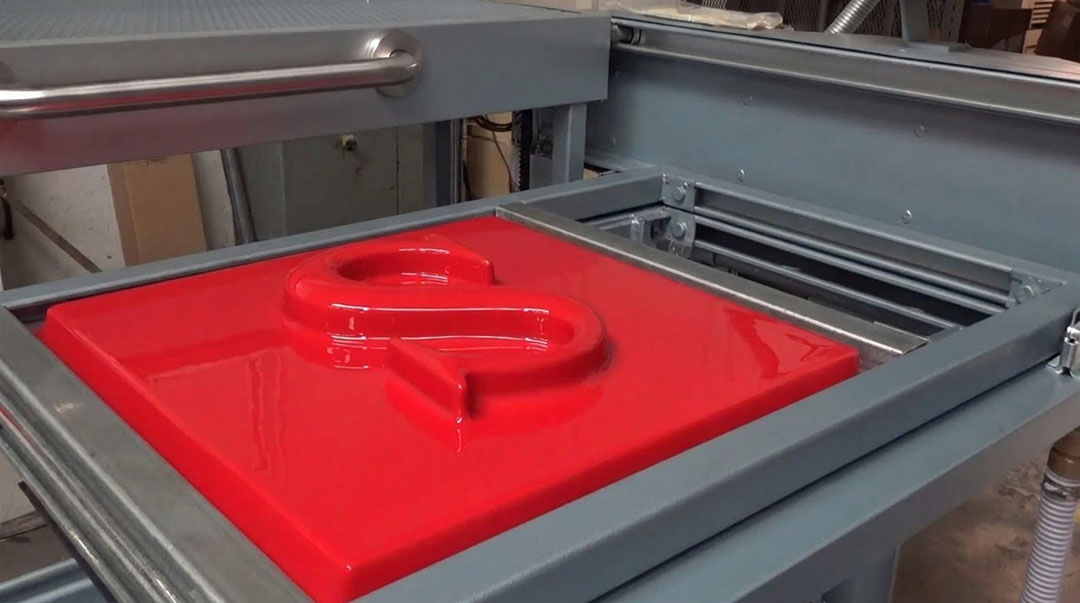
A channel letter face or a formed sign cabinet doesn’t look bad because the acrylic was the wrong grade. It looks bad because the machine that formed it couldn’t hold consistent heat and even vacuum across a wide, thin sheet. The face comes off the mold looking fine, then shows uneven gloss, thin corners, or visible drape lines once it’s lit at night.
Why Sign Faces Are a Different Forming Problem
Signage work isn’t deep-draw the way a skylight dome is, but it comes with its own set of demands. Sign faces are wide, often thin-gauge, and need to form with zero visible distortion because every flaw shows up the moment backlighting hits it. A machine built for small parts or heavy industrial trays doesn’t have the sheet size or heater evenness signage manufacturers need.
Wide-format sheets heat unevenly on undersized machines, with the center of the sheet reaching forming temperature before the edges catch up. That mismatch pulls the material thin in some areas and leaves it stiff in others, so the finished face has soft spots that show as light bleed once it’s mounted over LEDs. Return edges on cabinet faces and letter returns need sharp, consistent draws, and a machine without enough vacuum capacity across the full sheet width will leave rounded corners where crisp ones are expected.
Why the Fix Is Machine Capacity, Not Operator Skill
Shops running signage often blame heat settings or cycle time for defects that are actually a machine limitation. No amount of adjusting soak time fixes a heater bank that can’t hold even temperature across a 4×8 or larger sheet. Channel letters, cabinet faces, dimensional lettering, and illuminated push-through signage all share the same core requirement: uniform heat and strong vacuum across a wide, thin-gauge sheet, which is a different engineering problem than deep industrial parts. Our custom large-format machines are configured around the sheet sizes and draw geometry signage shops actually run, so wide sign faces get the same even, full-sheet forming as any other large part in the mix.
What Actually Separates a Capable Sign-Forming Machine From an Underpowered One
Most spec sheets look similar until a shop is running signage at volume rather than a single sample piece.
| What to check | Why it matters for sign faces |
|---|---|
| Sheet size capacity | Cabinet faces and large channel letter sets often exceed standard 4×8 sheets; undersized platens force seams or multiple pours |
| Heater zone evenness | Thin-gauge sheets show every hot or cold spot as a visible flaw once backlit, so even heat across the full width is non-negotiable |
| Vacuum coverage across sheet width | Wide sheets need consistent draw edge to edge, not just at the center, to keep return depth and corner sharpness uniform |
| Mold changeover speed | Sign shops run varied letter sets and cabinet sizes; slow tooling swaps eat into throughput on multi-order runs |
| Surface handling and clarity protection | Sign faces are a finished, visible product; scratches or dust picked up during loading show up as permanent defects |
Shops that choose equipment on price alone tend to discover these gaps on the first large order, when faces come back with visible hot spots or inconsistent returns and the only workaround is running well under the machine’s rated sheet size.
Automation and Throughput for Repeat Sign Production
A shop building one custom cabinet a month has different needs than one running repeat channel letter sets across multiple clients. PLC-controlled, multi-zone systems hold tighter tolerances run after run and cut the operator judgment calls that lead to inconsistent batches, which matters most for shops with standing signage contracts rather than one-off jobs.
Matching Machine Size to a Sign Shop’s Full Product Mix
Few signage manufacturers form only one product type. Most run cabinet faces, channel letters, dimensional lettering, and push-through lit graphics through the same equipment, which means the right machine isn’t sized around a single sign, it’s sized around the full range of sheet sizes and draw depths moving through the shop. Belovac has built thermoforming equipment in Banning, California since 1984, and financing through Univest Capital is available for shops weighing a large-format purchase against the ongoing cost of scrap and rework on undersized equipment.
Choosing the Right Machine Comes Down to the Sign You’re Actually Forming
Every sign shop evaluating equipment is answering the same question: does this machine have the sheet capacity, heater evenness, and vacuum coverage the work requires, or will every run be a fight against the equipment’s limits. That’s a match between sign geometry and machine capability, not a spec sheet comparison.
Request a quote and we’ll help confirm the right machine for your sheet sizes and production volume before you commit to equipment.