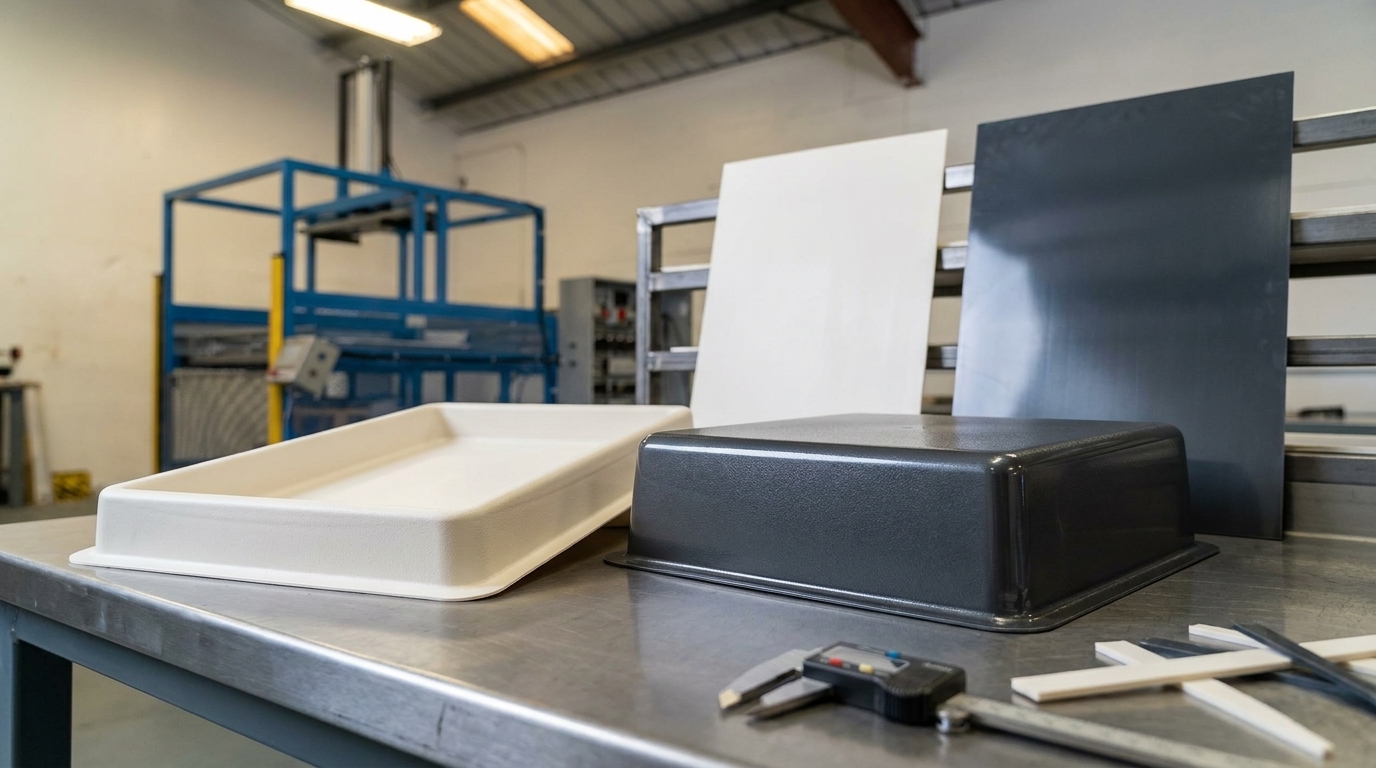
HIPS and ABS compete for the same vacuum forming applications across nearly every production environment. Both are amorphous thermoplastics, both form on the same equipment at similar temperatures, and both are available in standard gauges from most plastic sheet suppliers. For lower-demand applications, either material will often work — which is why the selection often defaults to cost rather than material fit.
That default gets expensive when the application actually has a performance requirement. Understanding the real production-level differences between HIPS and ABS — how they behave on the machine, how the parts hold up in service, and which applications each material is actually suited for — makes the selection decision much more useful than a simple price comparison.
Where HIPS and ABS Overlap on the Production Floor
The processing similarity between HIPS and ABS is genuine. Both materials form at temperatures in the 280 to 350 degree Fahrenheit range, though the specific window varies by grade. Both take detail well from textured mold surfaces. Both release cleanly from aluminum and epoxy tooling with standard draft angles. Neither requires pre-drying under normal production conditions. For a facility already running one of these materials, switching to the other requires minimal equipment or process adjustment.
This overlap is why they’re often treated as interchangeable in equipment selection conversations. In practice, interchangeability is limited to applications where structural performance, surface finish, and chemical exposure requirements are all low. Outside that range, the differences matter.
Where the Two Materials Split in Physical Performance
HIPS — high-impact polystyrene — is a general-purpose styrene resin modified with polybutadiene rubber to improve impact resistance over standard polystyrene. It’s stiffer than ABS at equivalent gauges and carries a lower material cost. But its impact resistance, despite the name, is lower than ABS in direct comparison. Its chemical resistance is more limited, and it’s susceptible to stress cracking when exposed to oils, greases, and common cleaning agents.
ABS derives its properties from three monomers: acrylonitrile for chemical resistance and heat performance, butadiene for toughness and impact strength, and styrene for processability and surface gloss. The result is a material that outperforms HIPS on impact resistance, chemical resistance, and overall part toughness. It also produces better surface quality from textured molds and accepts paint and adhesives more consistently. That performance premium comes at a higher material cost per pound.
How Each Material Behaves Under the Heater
HIPS reaches its forming temperature slightly faster than ABS at equivalent gauge, which can provide a modest cycle time advantage in high-throughput production. But it has a narrower processing window. Overheating HIPS produces surface blistering, degraded properties, and color shift. Hitting the lower edge of its temperature range produces incomplete forming and springback. Tighter temperature control is required to consistently stay within the acceptable forming band.
ABS tolerates a wider forming temperature range. It’s more forgiving when heating conditions vary across a shift, when sheet gauge has some natural variation, or when heater calibration isn’t perfectly maintained. For operations where process control is less tightly managed, ABS’s wider window reduces scrap from temperature-related forming problems. For operations with well-calibrated equipment and consistent material supply, the processing difference between the two materials is less significant.
Surface Quality and Paintability After Forming
This is where the difference between HIPS and ABS becomes most visible in the finished part.
ABS produces better base surface finish from textured molds, holds finer grain detail more consistently, and accepts paint, primer, and adhesive bonding more readily. For parts that will be painted, grained to a specific finish standard, or assembled with bonded components, ABS’s surface quality and adhesion properties justify the cost premium over HIPS.
HIPS is paintable and accepts most standard post-forming operations, but its base surface finish is typically lower gloss and more variable. For parts that are hidden in service, over-molded, or covered by applied materials, the surface difference between the two is irrelevant. For visible parts held to an appearance standard, the difference shows.
Side-by-Side Production Comparison
| Property | HIPS | ABS |
|---|---|---|
| Material cost | Lower | Higher |
| Impact resistance | Moderate | Higher |
| Chemical resistance | Limited | Better across most common chemicals |
| Processing window | Narrower | Wider |
| Surface finish quality | Adequate | Better from textured molds |
| Paintability | Good | Good to excellent |
| Food-contact grades | Available | Available (select grades) |
| UV resistance | Poor | Poor (both need protection for exterior use) |
| Typical draw ratio limit | 0.75:1 to 1:1 | 1:1 to 1.5:1 |
Choosing the Right Material for Your Application
The selection between HIPS and ABS consistently comes down to three factors.
Physical demands on the finished part. If the part will take impact loading, see chemical exposure, or carry structural load in service, ABS is the safer selection. HIPS is appropriate for low-demand applications where none of those stresses are present.
Surface finish and assembly requirements. If the part is visible to the end user and will be painted or finished to an appearance standard, ABS’s surface quality advantage is meaningful. If the part is hidden in service or will be covered, the surface difference doesn’t affect the end product.
Volume and cost math. At high production volumes, the per-pound cost difference between HIPS and ABS compounds significantly across the total material spend. If HIPS genuinely meets the application requirements, the cost savings across a large production run are real. The mistake is selecting HIPS on cost without confirming that the material performance matches the application.
The vacuum forming material selection guide covers both materials alongside the broader thermoplastic range used in production. For manufacturers evaluating equipment for HIPS or ABS production and looking to match machine configuration to their application requirements, Belovac’s team is available to help through the selection process.