
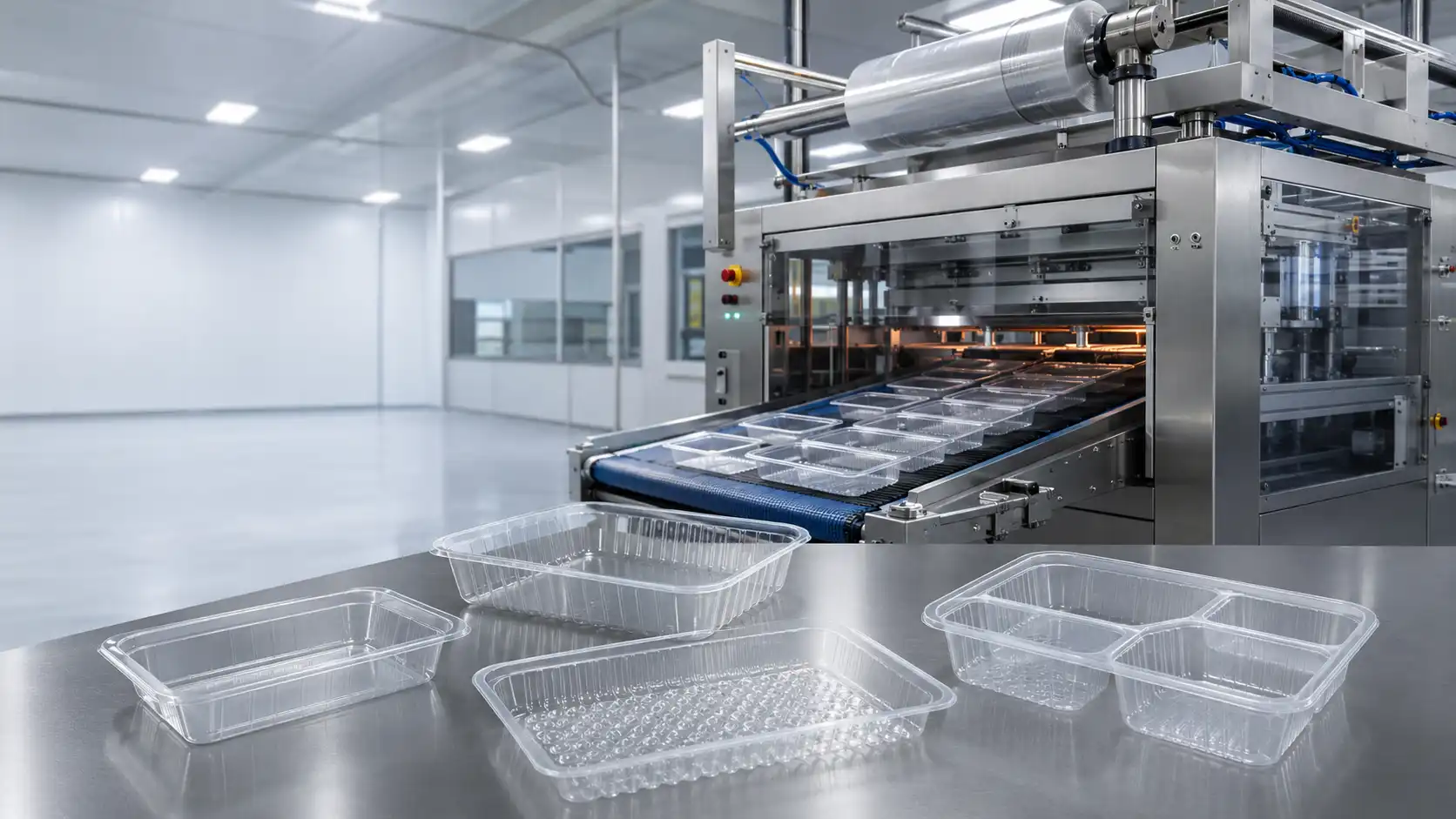
Food trays look simple. A flat bottom, raised walls, maybe a few dividers keeping the protein away from the sauce. But behind every thermoformed food tray is a set of engineering decisions that determines whether that tray holds its shape at 35°F in a refrigerated case, survives a 200-foot conveyor run without cracking, and stacks cleanly enough to survive palletized freight. Thermoforming is how the food packaging industry builds to those specs at scale, and it has been for decades.
The process is well-suited to food tray production specifically because it gives packaging engineers direct control over tray geometry, wall thickness, cavity depth, and material selection, all while keeping tooling costs low enough to support custom runs that would be economically impossible in injection molding. That flexibility is why thermoforming food trays dominate nearly every segment of food retail packaging, from deli counters to grocery produce sections to commercial bakeries.
How the Thermoforming Process Builds a Food Tray
Thermoforming starts with a flat thermoplastic sheet, which is loaded into the machine and moved through a heating zone. The heaters, typically quartz or ceramic infrared elements, bring the sheet to a precise forming temperature where the material becomes pliable without losing structural integrity. The heated sheet is then positioned over a food tray mold and drawn down into the cavity using vacuum pressure, atmospheric pressure, or a combination of both depending on the forming method.
Once the sheet conforms to the mold and cools, the formed tray is trimmed from the web material surrounding it. In automated inline configurations, this entire sequence runs continuously, with formed and trimmed trays exiting the machine ready for downstream filling, sealing, or stacking operations. The speed of the cycle and the consistency of the output are what make thermoforming food product packaging viable at commercial production volumes.
The mold design governs the tray’s final geometry. Cavity depth sets the draw ratio, which determines how much the material stretches during forming. Wall angle, or draft angle, must be sufficient to release the tray from the mold cleanly without deforming the walls. Rib patterns and bottom profiles can be engineered into the mold to improve rigidity and stacking clearance. None of this requires retooling the machine; it requires engineering the mold to match the tray specification.
Tray Types the Process Handles Well
Food thermoforming covers a wide range of tray formats, each with distinct geometry and performance requirements. Understanding where these formats differ helps clarify why thermoforming is the preferred production process across so many food categories.
Meat and poultry trays represent some of the highest-volume thermoformed food packaging produced. These trays require a defined cavity depth to hold liquid and maintain product separation, along with sufficient rigidity to support weight without flexing. They are almost universally produced from HIPS or expanded polystyrene and are designed for high-speed inline production where cycle rates directly affect cost per unit.
Produce trays, by contrast, are often designed with ventilation in mind. Vented tray configurations can be engineered into the mold without adding secondary operations, and the lighter wall thicknesses used for produce packaging allow faster cycle times. Bakery trays typically require deeper draw depths and broader footprints to accommodate items like muffins, rolls, or pastries. Multi-compartment trays for meal kits, prepared foods, and snack packs require molds with internal divider geometry machined to prevent cross-contamination between compartments while keeping the overall tray footprint compact.
| Tray Type | Key Design Requirements | Common Materials | Typical Production Volume |
|---|---|---|---|
| Meat and poultry trays | Defined cavity depth, liquid retention, rigidity | HIPS, expanded polystyrene | High-volume inline runs |
| Produce trays | Ventilation options, lighter wall thickness | PET, HDPE, PP | Mid to high volume |
| Bakery trays | Deep draw, wider footprint | HIPS, PP, PET | Mid volume, variable SKUs |
| Multi-compartment / meal trays | Internal divider geometry, stacking clearance | PP, CPET, HIPS | Variable, often short to mid run |
| Deli and prepared food trays | Clarity, defined wall height, lid compatibility | PET, PP, HIPS | Mid to high volume |
Each of these formats can be produced on thermoforming equipment with the appropriate mold and material combination. The machine configuration determines how efficiently each format runs at a given production volume.
Where Customization Actually Lives in Tray Production
One of the persistent misconceptions about food tray thermoforming is that customization means only the logo or label changes. The actual customization happens at the mold level, and it is more extensive than most buyers expect when they first evaluate thermoforming for a new application.
Cavity geometry is fully engineered to the application. A tray for fresh-cut fruit needs a different bottom profile than a tray for marinated chicken thighs. Wall angles are set to allow clean mold release at production speeds without causing the tray to distort. Corner radii affect how material distributes through the draw, which in turn affects wall thickness consistency across the tray body. These are not standard adjustments; they are engineering decisions made at the mold design stage.
Compartment configurations for multi-cavity trays require precise divider height relative to the tray rim to allow lid sealing across the full tray surface. Get that geometry wrong and the sealing equipment cannot create a consistent barrier, which creates a quality control failure downstream. Thermoforming allows these divider geometries to be built directly into the mold rather than added as secondary inserts, which reduces per-unit cost and improves consistency.
Stacking lugs and nesting features can also be incorporated at the mold level. These allow filled trays to stack without the upper tray contacting the product below, which matters in refrigerated distribution environments where tray-on-tray contact can compromise food contact surfaces. For packaging engineers evaluating food thermoforming, this level of mold-level customization is part of what separates the process from alternatives like injection molding, where tooling changes at this level carry significantly higher costs.
Material Selection and Food Safety Compliance
Food tray thermoforming relies on thermoplastics that are approved for direct food contact. The material selection affects not only food safety compliance but also forming behavior, clarity, rigidity, and whether the tray can withstand refrigerated or frozen storage temperatures without becoming brittle.
PET is widely used in produce, deli, and bakery tray applications where clarity matters at retail. PP handles temperature variation well and is a common choice for meal trays that move through heating cycles. HIPS offers good rigidity and processability for high-volume meat tray runs. CPET, a crystallized form of PET, is used in trays designed for ovenable prepared meal applications.
For a detailed breakdown of material characteristics and forming behavior across food-grade thermoplastics, this guide to plastic selection for food thermoforming covers the key properties and trade-offs across each material type. The U.S. Food and Drug Administration also maintains guidance on food contact substances and packaging materials relevant to compliance decisions during material selection.
Matching Machine Configuration to Food Tray Production Volume
The thermoforming machine running a food tray application needs to match the production requirements of the format. This is where buyers evaluating thermoforming equipment for food packaging need to think clearly about volume, cycle speed, and automation level before specifying a machine.
Sheet-fed configurations, including manual and semi-automated machines, are practical for custom or short-run food tray applications where flexibility between SKUs matters more than raw throughput. A packaging operation producing a range of specialty tray formats in lower volumes, or a manufacturer entering thermoforming for food packaging for the first time, may find a sheet-fed machine the right balance of capability and investment.
Inline roll-fed configurations are built for continuous, high-volume tray production. Roll-fed machines feed thermoplastic sheet from a continuous roll, form and trim parts inline, and can run at cycle rates that sheet-fed machines cannot match at scale. For commodity food tray production, where cost-per-unit is tightly managed and production consistency is critical, roll-fed thermoforming is the operating standard. The Belovac BV A-Class series, which includes a chain drive high-speed inline roll-fed configuration, is built for exactly this type of high-output food packaging application.
Dual-station configurations improve throughput for operations running thicker materials or complex tray geometries that require longer heat soak cycles. By heating one sheet while forming another, dual-station machines eliminate the cycle dead time that can limit output on single-station equipment running demanding food tray applications.
For buyers not yet certain which machine configuration matches their production model, Belovac’s full machine lineup covers the complete range from entry-level sheet-fed machines to fully automated PLC-controlled systems engineered for high-volume production.
What to Evaluate Before Committing to a Food Tray Thermoforming Setup
Before specifying equipment or committing to mold tooling for a food tray thermoforming operation, there are several production variables worth working through carefully.
- Tray geometry and draw ratio. Deep-draw trays require more material stretch and more precise heat distribution than shallow formats. Confirm the machine’s forming depth capability matches the deepest cavity in your tray spec.
- Annual production volume and SKU count. High-volume single-SKU operations point toward roll-fed automation. Multi-SKU operations with frequent mold changes need machines that minimize changeover time.
- Material gauge and compatibility. The forming temperature range and heater output of the machine need to match the material thickness and type specified for the tray. Not every machine handles every gauge and material combination equally well.
- Downstream integration. If trays are moving directly into filling and sealing lines, the thermoformer’s output format and tray orientation need to match the infeed requirements of downstream equipment.
- Regulatory material requirements. Food contact compliance needs to be confirmed at the material specification stage, not after tooling is cut.
Thermoforming food trays is a technically straightforward process when the machine, mold, and material are properly matched to the application. When they are not, the problems surface quickly in the form of wall thickness variation, tray warpage, sealing failures, or cycle rates that cannot meet production targets. Getting the specification right before equipment selection is the work that prevents those problems.
Belovac has been manufacturing thermoforming equipment in the USA for over 40 years. If you are evaluating machine configurations for a food tray production line or looking to scale an existing thermoforming operation, request a quote to discuss your application with the Belovac team directly.