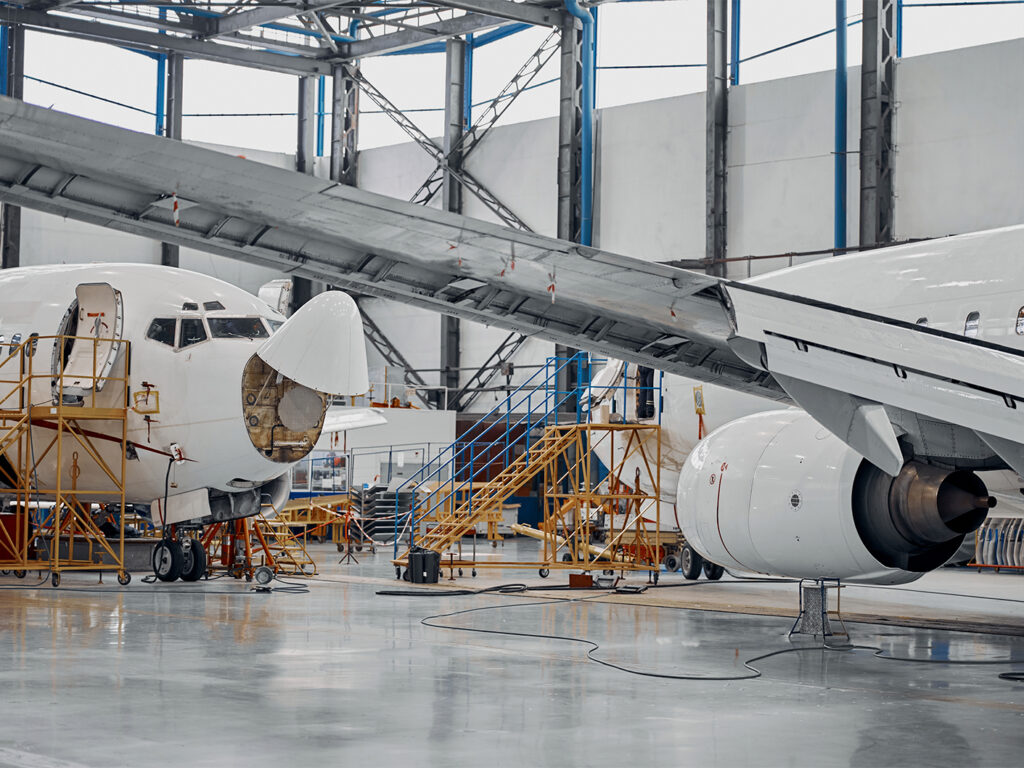
Why Aerospace Manufacturers Choose Vacuum Forming
Metal fabrication and fiberglass-reinforced plastic dominated aerospace interior manufacturing for decades. Both methods remain necessary for structural and load-bearing applications. For cabin interiors, however, vacuum forming has become the standard production method because it produces lighter parts faster and at lower tooling cost than either alternative, without sacrificing the dimensional consistency that aircraft assembly requires.
Weight Reduction and Fuel Efficiency
Thermoplastic vacuum-formed panels weigh significantly less than equivalent FRP or aluminum panels. In commercial aviation, weight reduction at the component level compounds across an entire cabin. FR-rated ABS and polycarbonate grades used in vacuum-formed interior panels meet FAR 25.853 requirements while contributing to overall aircraft weight targets that affect fuel burn across the operational life of the aircraft.
Dimensional Consistency Across Production Runs
Aircraft interior components must fit within certified cabin configurations. A seatback shell or overhead bin liner that measures outside tolerance cannot be installed without affecting the certified interior layout. Vacuum forming produces consistent part geometry across production runs when forming parameters are controlled, making it suitable for applications where part-to-part repeatability is a certification requirement.
Lower Tooling Cost and Faster Prototyping
Vacuum forming tooling costs a fraction of injection molding tooling for equivalent part sizes. For aerospace interior components, which are frequently updated with cabin refresh programs and aircraft reconfigurations, lower tooling cost means design changes can be implemented without the tooling investment that injection molding would require. Prototype parts can be produced in days from CNC-machined or 3D-printed molds before committing to production tooling.
Surface Finish and Customization in a Single Operation
Pre-colored, textured, and surface-treated thermoplastic sheets allow aerospace interior panels to achieve their final appearance directly from the forming process. Secondary painting and coating operations are eliminated, reducing production steps and the risk of finish inconsistency across a cabin installation.
Durability in the Cabin Environment
Cabin interior components are exposed to cleaning chemicals, passenger impact, temperature cycling between ground and cruise altitude, and UV exposure near window locations.
FR-rated ABS and
KYDEX-series materials used in vacuum-formed aerospace components are formulated to maintain structural integrity and surface appearance under these conditions across the operational service life of the aircraft.
Vacuum Forming Applications in Aerospace
Vacuum forming is used across the cabin interior, cargo zones, galley, lavatory, and avionics areas of commercial, business, and military aircraft. Each application area carries its own material specification, dimensional tolerance, and production volume requirement.
- Cabin interior panels: Sidewall panels, ceiling panels, and bulkhead faces are the highest-volume aerospace vacuum forming application. Full-cabin-width panels require large-format forming capability with uniform temperature distribution across the entire sheet surface. Any temperature differential across a large panel produces visible witness lines in the finished surface, which constitute a cosmetic rejection in cabin interior applications.
- Overhead bin structures: Bin floor panels, back walls, and door liners require moderate draw depth with consistent wall thickness. Thinning at draw corners is a primary quality concern on deeper bin geometries and plug-assist tooling is often required.
- Seating area components: Seatback shells, armrest covers, tray table structures, and seat track covers must hold dimensional tolerances tight enough to assemble within certified seat configurations. FR-rated ABS is the standard material for these components.
- Cockpit and avionics housings: Custom enclosures for navigation display systems, instrument panel sections, and avionics rack covers require the tightest dimensional tolerances in aerospace vacuum forming due to fitment requirements against electronic assemblies.
- Ventilation and HVAC components: Air distribution ducts, diffuser housings, and cabin pressurization duct sections are formed from FR-rated ABS in complex cross-sectional geometries that require careful mold draft design for clean release.
- Cargo enclosures and liners: Cargo bin liners, equipment bay panels, and cargo door surrounds require heavy-gauge materials for impact resistance at lower dimensional tolerances than cabin interior components.
- Lavatory and galley fixtures: Wall panels, countertop surrounds, and storage inserts in galley areas require FDA-compliant material grades in addition to FAR compliance where food-contact surfaces are involved.
Belovac Machines for Aerospace Component Production
Aerospace applications span a wide range of part sizes and production volumes. The correct machine configuration depends on the forming dimensions your components require, the material gauges you are processing, and your production volume.
- Large-Format Vacuum Forming Machines: Configured for full-size cabin sidewall panels, ceiling panels, cargo enclosures, and bulkhead faces. Multi-zone Siemens PLC heat control and high-capacity vacuum systems handle large-format FR-rated sheet at the temperature precision aerospace materials require.
- BV E-Class 53×103: Dual-oven heat saturation for thick-gauge FR-ABS and polycarbonate at production dimensions covering most overhead bin, seating component, and mid-size structural part geometry.
- BV A-Class: Fully automated sheet feeding and programmable forming cycles for high-volume standardized cabin components where part geometry is fixed and production consistency is the primary requirement.
- BV C-Class: Manual cycle control for lower-volume, high-precision components including cockpit enclosures, avionics housings, and prototype parts where operator-controlled forming windows matter more than throughput.
Belovac’s engineering team reviews part drawings, material specifications, and production volume requirements to recommend the correct machine configuration for your aerospace application. Contact us to discuss your specific requirements.
Work With Belovac on Your Aerospace Application
Whether you are producing cabin interior panels, overhead bin components, cockpit enclosures, or cargo liners, Belovac has the machine configuration and 30 years of forming experience to support your production requirements. Our engineering team works directly with aerospace manufacturers and Tier 1 suppliers to match machine specifications to part geometry, material type, and production volume before you purchase.
Contact us to discuss your application or request a quote for the machine configuration that fits your production requirements.