
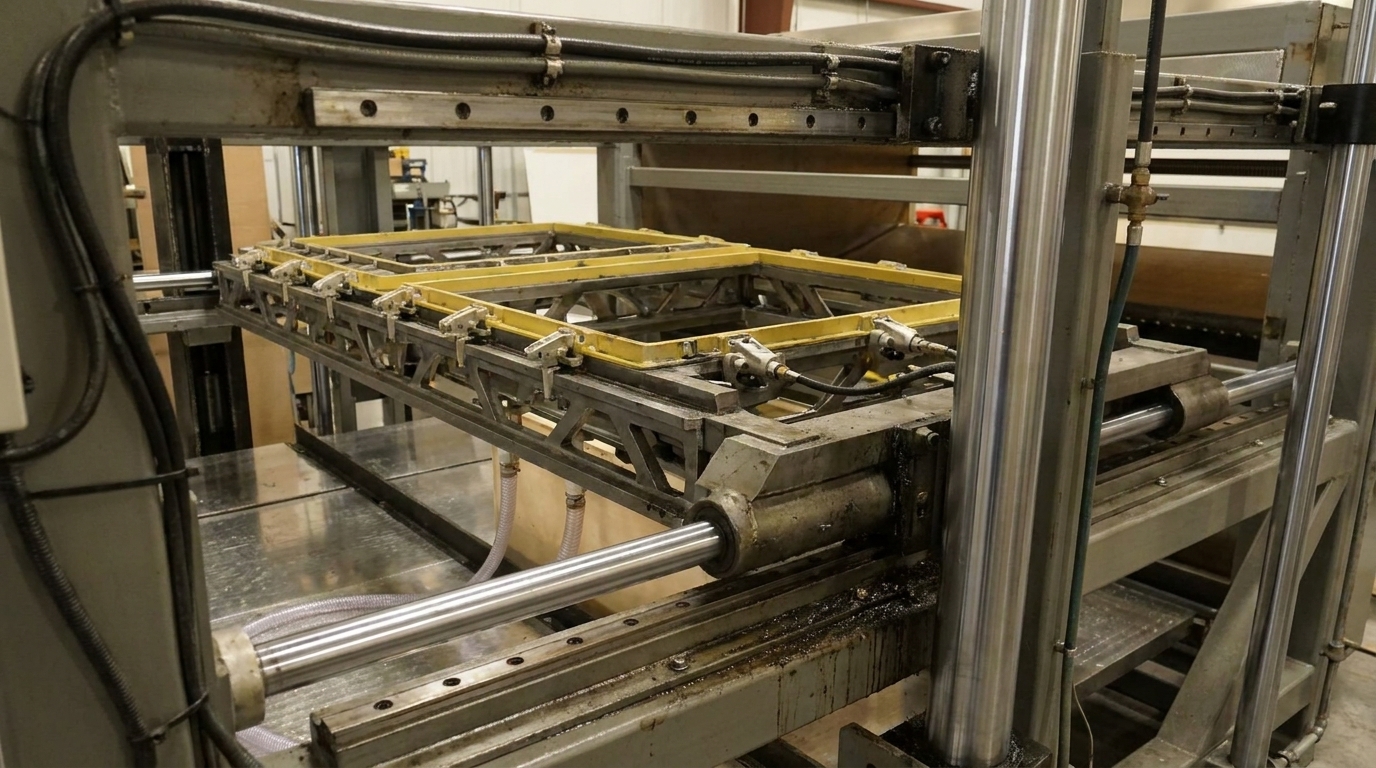
Draw depth gets treated as a fixed property of a machine, when it’s actually a byproduct of one spec most buyers never ask about: platen travel. Two machines with the same sheet size rating can form very different draw depths depending on how far the platen physically moves during the forming cycle, and that number rarely makes it onto the headline spec sheet.
Why Platen Travel Sets the Ceiling on Draw Depth
Platen travel is the distance the platen moves down into the mold cavity, and it directly caps how deep a part can be pulled regardless of how strong the vacuum system is. A machine with excellent vacuum capacity but limited platen travel will still bottom out on a deep part, because the sheet simply can’t be drawn any further once travel maxes out. Vacuum strength determines how well material seats into detail at a given depth, but travel determines whether that depth is reachable at all.
This is why two machines can quote the same sheet size and vacuum rating and still perform completely differently on the same deep-draw part. The one with shorter platen travel will show thinning, incomplete seating, or a part that simply doesn’t reach full depth, no matter how the heat and vacuum settings are tuned.
Where Platen Travel Gets Overlooked in the Buying Process
Most buyers compare sheet size and horsepower because those numbers are easy to find and easy to compare across brands. Platen travel is often buried in a spec table or missing from marketing materials entirely, so it doesn’t factor into the comparison until a deep part is already in production and coming out short. Our large format vacuum forming machines are built with platen travel sized to the draw depths large-format parts actually require, not just a sheet size rating that looks good on paper.
What to Confirm Before Comparing Draw Depth Claims
A machine’s advertised draw depth is only meaningful once these factors are checked against the parts a shop actually needs to form.
| What to check | Why it matters for draw depth |
|---|---|
| Rated platen travel distance | Sets the hard physical ceiling on draw depth, independent of vacuum strength |
| Vacuum capacity at full travel | Reaching maximum travel means nothing if vacuum can’t fully seat material at that depth |
| Plug-assist compatibility | Pre-stretches material before the platen reaches full travel, protecting wall thickness on deep parts |
| Heater zone reach relative to travel | Material needs to stay in-window through the full pull; heaters sized for shallow travel leave deep sections underheated |
| Tooling clearance at max travel | Mold height and platen travel need to be matched, or a deep mold won’t clear the frame at full stroke |
Shops that skip this check tend to find out mid-production, when a deep part that looked fine on a shallow test mold won’t fully form once tooling for the actual draw depth is installed.
Confirming Draw Depth Before Committing to a Machine
Every shop evaluating large format equipment for a deep-draw part is really asking whether platen travel supports the part’s actual depth, or whether the machine will bottom out before the part is fully formed. That’s a travel and tooling clearance question first, not a sheet size comparison. Belovac has built thermoforming equipment in Banning, California since 1984, and financing through Univest Capital is available for shops weighing a large-format purchase against the cost of scrap on parts that don’t reach full depth.
Request a quote and we’ll help you confirm the platen travel and draw depth your parts actually need before you commit to equipment.