
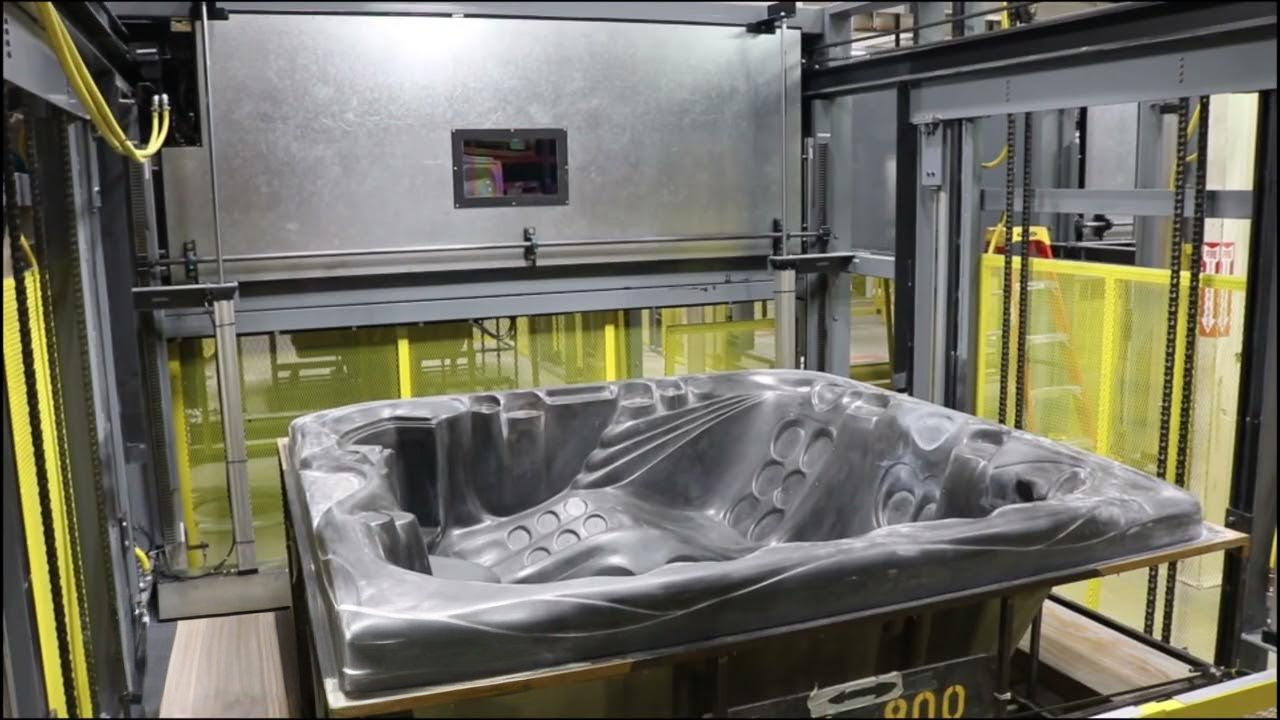
Custom hot tub manufacturing relies on controlled plastic forming methods that support complex shapes, consistent wall thickness, and repeatable results. Vacuum forming has become a preferred production process for molded spa shells and liners due to its ability to shape heavy-gauge thermoplastics with accuracy and efficiency. Through controlled heating, mold design, and vacuum pressure, manufacturers are able to create durable hot tub structures that meet both aesthetic and functional requirements.
Hot tub vacuum forming supports design flexibility while maintaining production stability. Acrylic sheets and reinforced thermoplastics can be shaped into ergonomic seating contours, integrated footwells, and smooth interior surfaces without excessive material waste. This manufacturing approach allows customization at the tooling level while supporting scalable production.
Hot Tub Production and The Vacuum Forming Process
Vacuum forming hot tubs involves heating thermoplastic sheets until pliable, followed by forming them over a custom mold using negative air pressure. The softened sheet conforms to the mold geometry as vacuum ports remove trapped air and apply uniform pressure across the surface. Once cooled, the formed shell retains its shape and structural integrity.
This process is well-suited for spa shells due to the size and depth required. Large-format vacuum forming machines allow deep draw forming without excessive thinning when heat distribution and draw ratios are carefully controlled. Proper clamping, heating zones, and mold venting ensure dimensional consistency throughout the part. This process ensures:
- Controlled sheet heating for even material flow
- Custom mold venting to prevent air entrapment
- Gradual cooling to reduce internal stress
Material Selection Used In Vacuum Forming Hot Tubs
Material choice directly affects durability, appearance, and long-term performance. Acrylic-capped ABS sheets are commonly used due to surface finish quality and resistance to chemicals, UV exposure, and thermal cycling. Heavy-gauge thermoplastics provide structural support while maintaining smooth interior surfaces.
Pre-drying of hygroscopic plastics is required before forming to prevent surface defects such as bubbling or blistering. Industrial drying ovens are often used to remove moisture and stabilize sheet temperature before the forming cycle begins.
| Material Type | Key Characteristics |
| Acrylic Capped ABS | Gloss finish, chemical resistance, color stability |
| High Impact Polystyrene | Cost-effective, moderate durability |
| PMMA Acrylic | Premium surface quality, higher rigidity |
Custom Hot Tub Molds And Tooling Development
Custom hot tub molds define the final shape, seating ergonomics, and internal geometry of the spa shell. Mold construction typically uses aluminum or epoxy tooling, depending on production volume and design complexity. CNC machining is often used to achieve precise contours and smooth transitions.
Vacuum channels and vent holes are integrated into the mold to ensure even material draw and prevent surface distortion. Draft angles are incorporated to allow proper release without damaging the formed part. Mold temperature control may also be used to improve surface consistency.
Custom hot tub molds support brand differentiation by allowing unique seat profiles, jet placements, and internal layouts while maintaining structural repeatability. This allows manufacturers to innovate without sacrificing performance, durability, or production efficiency.
Large Format Equipment Supporting Spa Shell Forming
Vacuum forming hot tubs requires machines capable of handling large sheet sizes and deep draw applications. Spa shell forming systems provide extended heating zones, reinforced frames, and high-capacity vacuum systems to support thick plastic sheets without sag or uneven thinning.
Manual, semi-automated, and fully automated configurations are used depending on production volume. Dual oven systems improve heat saturation for heavy gauge materials, while automated sheet handling increases cycle consistency in higher output environments. These systems allow for:
- Extended forming areas for oversized shells
- Zoned heating control for uniform draw
- High airflow vacuum systems
Design Flexibility And Customization Capabilities
One of the primary advantages of hot tub vacuum forming is design adaptability. Tooling changes allow variations in seat depth, lounge contours, and shell dimensions without altering the core production method. Textures, color variations, and surface finishes can be incorporated at the material level.
This flexibility allows manufacturers to respond to market preferences while maintaining consistent manufacturing practices. Prototype molds are often used during development phases to test ergonomics and flow before committing to production tooling.
Quality Control And Structural Performance
Quality assurance focuses on wall thickness distribution, surface finish, and dimensional accuracy. Infrared sensors, thickness gauges, and visual inspection help identify inconsistencies early in production. Reinforcement layers such as fiberglass backing are often applied post-forming to enhance strength and load capacity.
Proper vacuum forming parameters reduce internal stress and improve long-term durability under thermal expansion and water pressure. Controlled cooling cycles help preserve material properties throughout the shell.
Production Efficiency And Cost Control
Vacuum forming hot tubs offers favorable tooling economics compared to injection molding for large parts. Mold costs remain manageable while cycle times support scalable output. Material usage is optimized through trimming and recycling of excess sheet material.
Consistent machine setup and repeatable forming cycles reduce scrap rates and downtime. This efficiency supports both custom runs and standardized product lines without excessive retooling.
Equipment Built for Spa Shell Production
Manufacturers sourcing equipment specifically for this application can review Belovac’s spa and hot tub forming machines, built with the pneumatic clamping and deep draw capability needed for shells up to swim spa dimensions.
Why Manufacturers Work With Belovac
At Belovac, we build vacuum forming equipment suited for custom spa and hot tub production. Our machines are designed to support hot tub vacuum forming that requires large-format forming, deep draw capability, and stable handling of heavy-gauge materials. We offer clients:
- Large-format vacuum forming machines, ideal for spa and hot tub shell manufacturing
- Systems engineered for deep draw forming and heavy gauge thermoplastics
- Custom machine sizes aligned with unique hot tub molds
- Dual oven and zoned heating options supporting consistent forming results
- Engineering support focused on mold compatibility and process control
Consistent quality and production efficiency are supported across custom hot tub molds and evolving product designs. Contact us to discuss your hot tub vacuum forming requirements with our engineering team.