
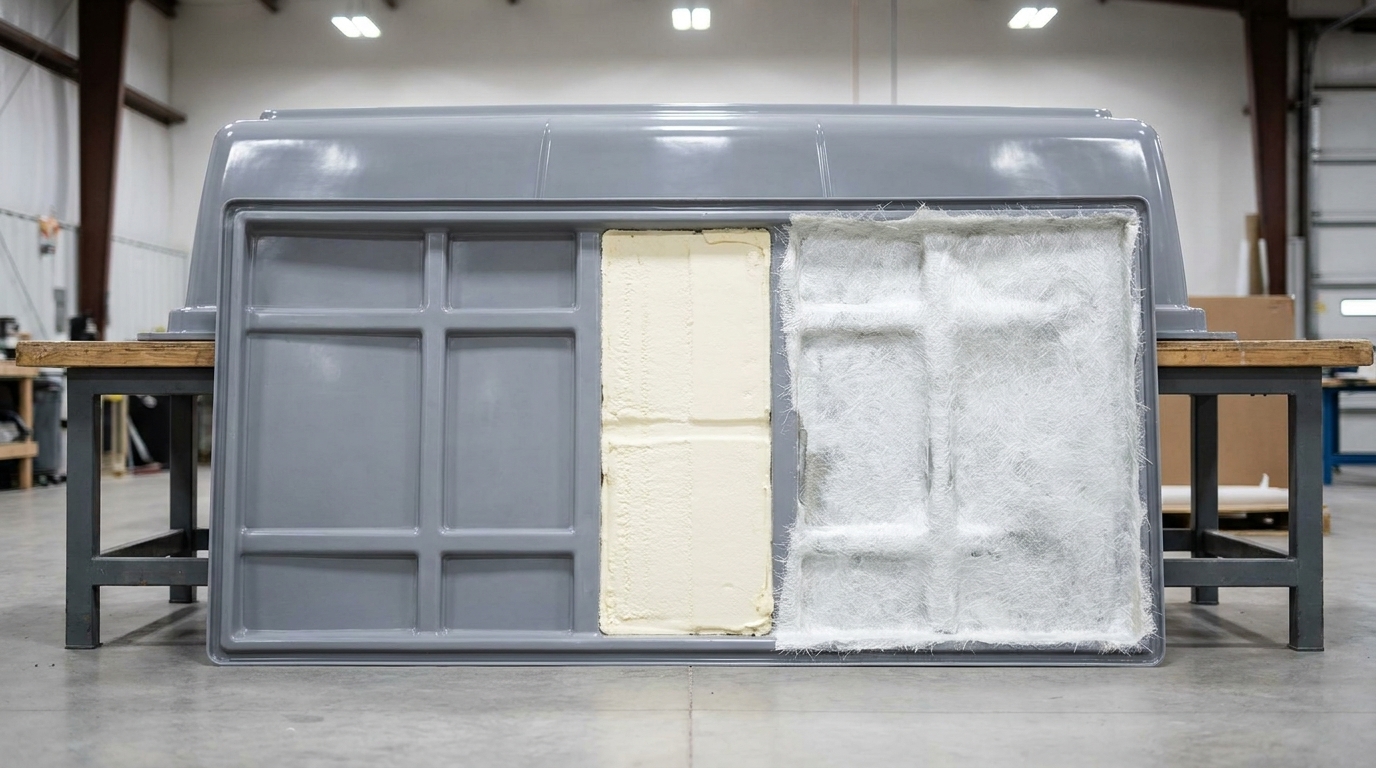
A large vacuum formed part gets its shape from the mold, but it gets its strength from what happens after forming. Thermoformed acrylic and plastic shells flex on their own once parts get large, and shops that skip reinforcement find that out the first time a panel takes a load it wasn’t built for.
Why Forming Alone Doesn’t Make a Part Structural
Vacuum forming produces a thin, consistent shell, and that shell is excellent for surface finish, weather sealing, and complex geometry, but it isn’t inherently rigid at large sizes. A big flat panel or a shallow-curved cover can flex under its own weight, wind load, or foot traffic, and without added reinforcement that flex eventually shows up as stress cracking or permanent deformation at the weakest point. Reinforcement isn’t a fix for a bad forming job, it’s a standard second step for any part that needs to carry load or resist deflection beyond what the shell material alone provides.
Ribbing: Building Strength Into the Mold Itself
Ribbing is reinforcement designed into the part’s geometry before it’s ever formed. Raised channels or ridges molded into the shell act like structural beams, increasing stiffness in the direction the rib runs without adding a separate material or process step. This works well for parts where the load direction is predictable, like a panel that needs to resist bending across its width, because the rib pattern can be placed exactly where the stress concentrates.
Ribbing has limits. It adds complexity to the mold, and a rib pattern that’s efficient for one load direction may do little for stress from a different angle. For parts with more demanding or less predictable load requirements, ribbing usually gets paired with backfill or backing rather than used alone.
Backfill: Filling the Shell for Mass and Rigidity
Backfill involves filling the formed shell, fully or in sections, with a rigid material such as foam or structural resin after forming. This adds mass and compression strength without changing the part’s outer geometry, which matters for parts where the visible surface has to stay exactly as formed. Backfill is common on parts that need to resist denting or impact, since a filled shell distributes point loads across a larger area instead of concentrating them on a thin unsupported wall.
The tradeoff is weight and cost. Backfill adds material and a secondary process step, so it tends to get reserved for parts where impact resistance or rigidity genuinely requires it, not applied as a default across every large part.
Fiberglass Backing: Reinforcement for Structural Load
Fiberglass backing bonds a fiberglass layer, often with resin, to the back of the formed shell after it comes off the mold. This is the reinforcement method used when a part needs to carry real structural load, not just resist flex or impact. Fiberglass backing is standard on larger architectural components, vehicle body panels, and enclosures that have to hold their shape under sustained mechanical stress, since it adds tensile and compressive strength the base shell material can’t provide on its own.
Fiberglass backing requires the part to be designed with bonding surface and cure time in mind from the start, since it’s applied as a distinct manufacturing step with its own tooling and handling requirements. Parts that need this level of reinforcement are usually flagged during design, not added as an afterthought once a formed shell turns out too flexible.
Matching Reinforcement to the Part’s Actual Load
These three methods aren’t interchangeable, and choosing the wrong one either overbuilds a part unnecessarily or leaves it underbuilt for its actual use.
| Reinforcement method | Best suited for | Key tradeoff |
|---|---|---|
| Ribbing | Predictable, directional bending loads on flat or shallow-curved panels | Adds mold complexity; less effective against loads from unexpected directions |
| Backfill | Impact resistance and rigidity without altering the formed surface | Adds weight and a secondary fill step; cost scales with fill volume |
| Fiberglass backing | Structural parts under sustained mechanical or load-bearing stress | Requires design-stage planning for bonding and cure; most involved process of the three |
Getting this right starts with forming a shell that’s consistent enough to reinforce predictably in the first place. A part with uneven wall thickness or webbing from an undersized machine won’t take ribbing, backfill, or fiberglass backing evenly, which undermines the reinforcement before it’s even applied. Our large format vacuum forming machines are built to produce the consistent wall thickness and surface quality that reinforcement methods depend on for large parts.
Planning Reinforcement Before the Part Is Formed
Every shop building a large formed part is really answering how much load it needs to carry, and matching that to ribbing, backfill, or fiberglass backing accordingly, rather than defaulting to one method regardless of the application. That’s a design decision worth making before tooling is built, not after a part fails in the field. Belovac has built thermoforming equipment in Banning, California since 1984, and financing through Univest Capital is available for shops weighing a large-format purchase against the ongoing cost of rework on parts that weren’t reinforced for their actual load.
Request a quote and we’ll help you confirm the reinforcement approach and forming setup your large part actually needs before you commit to equipment.