
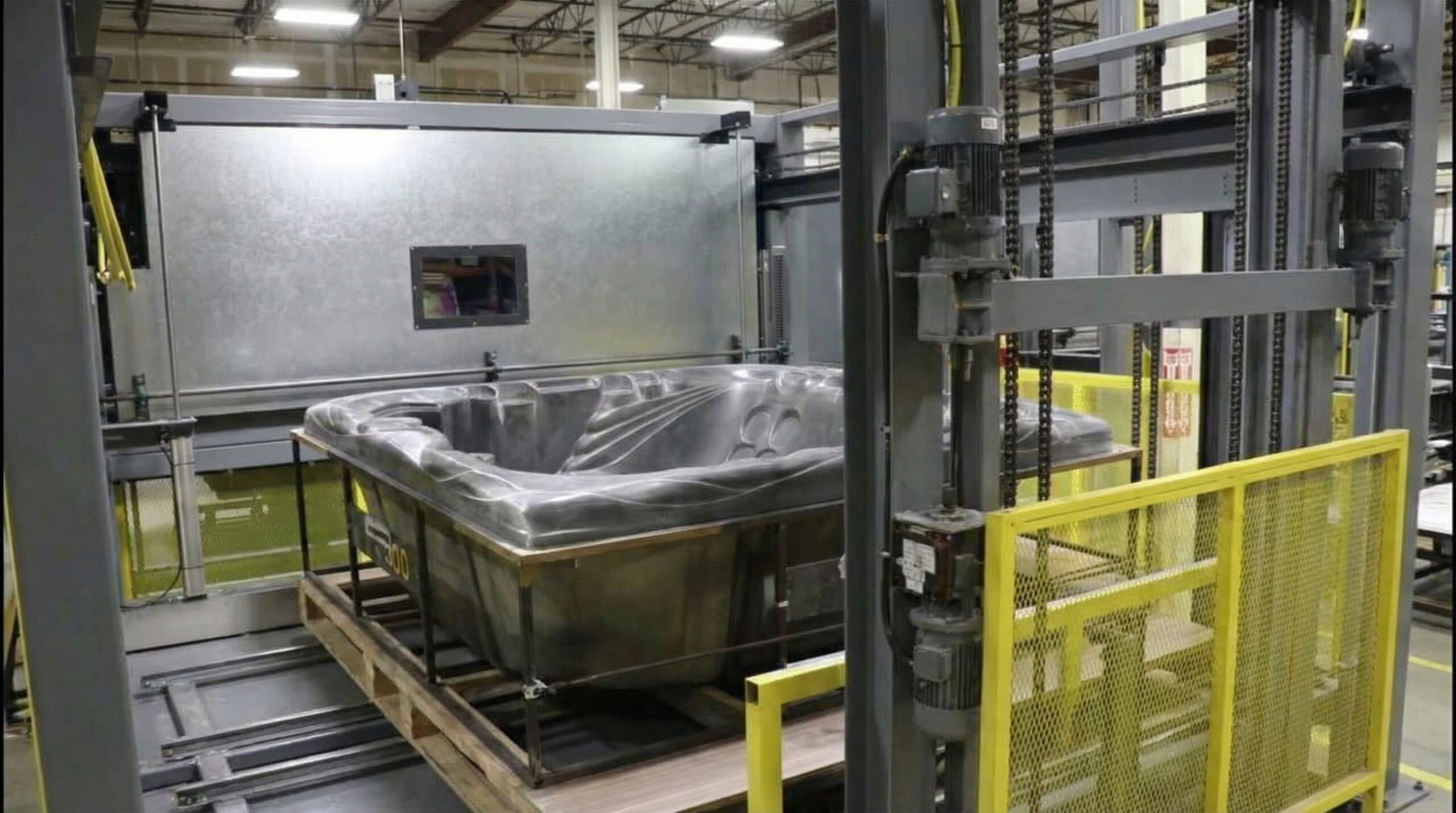
A spa shell doesn’t fail because of bad plastic. It fails because the machine forming it wasn’t built to hold heat and pressure evenly across ten feet of sheet. Corners cool faster than centers, deep-draw sections thin out, and by the time the shell reaches quality control, the defect is already baked in.
The Forming Problem Nobody Budgets For
Spa and hot tub shells are among the largest single-piece thermoformed parts made in any industry. A full swim spa can require a forming surface running 8 to 10 feet across, with draw depths deep enough to shape jet pockets, seating contours, and footwells in one pull. That scale is exactly what purpose-built spa and hot tub forming machines are engineered around, and it’s exactly what standard equipment isn’t.
Heater banks sized for a 24×48 tray can’t maintain even temperature across a sheet four times that size. Vacuum systems built for shallow trays can’t generate the sustained draw needed to pull heavy-gauge acrylic into a footwell without thinning the wall. The shell comes off the mold looking fine and then shows stress cracking or warping days later, once it’s under load.
Why the Fix Is Machine Capacity, Not Technique
Operators get blamed for defects that are actually a hardware limitation. No amount of adjusting heat timing or cycle speed compensates for a machine that doesn’t have enough heater zones, clamping force, or vacuum capacity for the part in front of it. Large format machines exist because spa shells, RV panels, and architectural components all share the same requirement: even heat and consistent draw across a much bigger surface than standard equipment was designed for.
The SPE Thermoforming Division has identified heat uniformity as one of the leading variables in large-part forming defects, which tracks with what shows up on the shop floor: shells that warp or crack almost always trace back to a temperature gradient the machine couldn’t correct for during the cycle.
What Actually Separates a Capable Machine From an Underpowered One
Spec sheets make every large format machine sound similar. The differences that matter show up once you’re running production, not during the demo.
| What to check | Why it matters for spa shells |
|---|---|
| Independent heater zones | Flat panels and deep-draw jet pockets need different heat profiles at the same time; fewer zones means compromising one to protect the other |
| Clamping pressure per linear foot | Heavy-gauge acrylic and ABS sheets need enough clamping force to stay rigid through the full heat cycle without slipping or sagging |
| Vacuum draw capacity | Deep footwells and seating contours need sustained vacuum, not just peak vacuum, to pull material fully into the mold without thinning |
| Forming area and draw depth | A machine rated for a 6-foot sheet won’t safely run a 10-foot swim spa shell, regardless of what the heater specs say |
| Material compatibility | ABS, acrylic, and KYDEX all respond differently to heat ramp speed and cooling; the machine’s control system needs to accommodate that range |
Buyers who evaluate on sticker price alone tend to find out about these gaps after the first production run, when shells start coming out inconsistent and the only fix is running the machine below its rated capacity.
How Belovac’s Spa and Hot Tub Machines Are Built
Belovac’s large format line is built specifically around this problem. Pneumatic clamping delivers up to 300 foot-pounds of pressure per linear foot, which keeps heavy-gauge sheet rigid through the full forming cycle instead of allowing it to sag or shift. A Siemens PLC controls up to eight independent heating zones, so a flat panel section and a deep jet pocket on the same sheet can each get the heat profile they actually need, rather than a single averaged setting.
These machines run ABS, HIPS, KYDEX, acrylic, HDPE, and polycarbonate, covering the materials most spa and hot tub manufacturers are already specifying. Belovac has built thermoforming equipment in Banning, California since 1984, and the large format line reflects four decades of adjustments made specifically because of problems like uneven wall thickness and shell warping. Financing through Univest Capital is also available for manufacturers weighing a large format purchase against the ongoing cost of scrap and rework on undersized equipment.
Choosing the Right Machine Comes Down to the Part You’re Actually Forming
Every manufacturer evaluating spa forming equipment is really answering one question: does this machine have the zone control, clamping force, and vacuum capacity my shells require, or will I be fighting it on every run? The same sizing problem shows up anytime a part moves into oversized territory, which is why Belovac builds its large format vacuum forming machines on the same zone-controlled platform as its spa equipment.
Automation level matters just as much as raw capacity. A shop running one custom shell a week has different needs than one running dual-station production, and Belovac’s PLC control options scale from manual single-zone setups to fully automated multi-zone systems built for repeat runs.
If you’re ready to move forward, Belovac’s spa and hot tub forming machines are built to handle exactly this kind of oversized, deep-draw shell work. Picking the right spa forming machine isn’t really a shopping decision, it’s an engineering match between your shell geometry and the machine’s zone control, clamping, and vacuum capacity. Request a quote and we’ll help you confirm the match before you commit to equipment.