
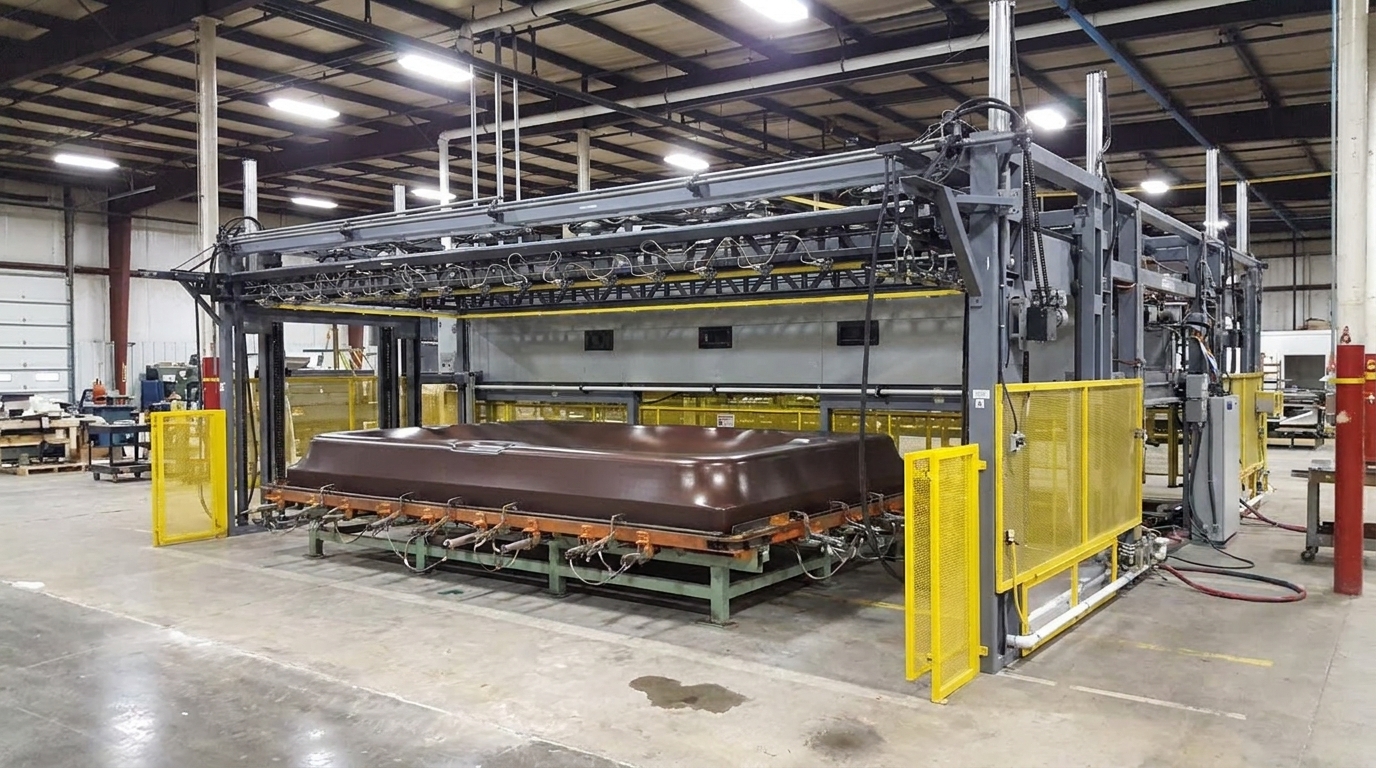
A swim spa shell is one of the largest single-piece vacuum formed components produced in commercial manufacturing. Unlike a standard hot tub shell, which typically fits within a 7×8 foot footprint, swim spas extend to 10, 12, 15, or even 20 feet or more in length. That scale changes nearly every variable in the manufacturing equation.
The process for producing these shells is large-format vacuum forming. Understanding how that process works, what it demands from equipment and tooling, and where it creates production challenges is useful for any manufacturer producing swim spa components at volume or evaluating equipment to do so.
How Swim Spas Differ from Standard Spa Shell Production
At standard hot tub dimensions, most production complexity comes from mold geometry: deep draw contours for seating, neck rests, and footwells. Sheet size is large but manageable on mid-range vacuum forming equipment, and the production footprint fits within a conventional manufacturing facility layout.
Swim spas change the equation in several significant ways. Shell length alone pushes past the forming area of most industrial machines. The structural loads are different. A swim spa functions as both a relaxation vessel and an aquatic exercise environment, placing greater stress on shell rigidity and wall thickness consistency across a much larger surface area. The weight of the finished part affects how tooling is mounted, how parts are handled after forming, and how much time is built into each production cycle for cooling and release.
Why Acrylic Dominates Swim Spa Shell Production
Acrylic sheet is the standard material for swim spa shell production. It forms well under heat, holds its shape through the cooling cycle, and provides the surface clarity and color depth that spa buyers expect. Gelcoat-backed acrylic is the most common construction method, where a fiberglass reinforcement layer is applied directly to the formed shell to add structural rigidity without a separate internal structural component.
UV stability is non-negotiable for outdoor swim spas. A shell that oxidizes, fades, or checks under prolonged sun exposure creates warranty liability and shortens the product’s marketable life. Grade selection at the sheet level matters considerably, and spa-grade UV-stabilized acrylic from qualified sheet suppliers is standard practice. The Society of Plastics Engineers maintains technical documentation on thermoplastic material performance criteria relevant when evaluating acrylic grades for outdoor production environments. For a broader look at material selection in vacuum forming, the vacuum forming material selection guide covers key considerations by plastic type.
The challenge acrylic presents at swim spa scale is forming uniformity. Large sheets require even heat distribution across the entire surface before the draw begins. Hot spots produce thinned walls. Cold spots resist forming and can crack under draw pressure. Heater zone control at the machine level becomes especially important when a sheet spans 12 or more feet in a single forming cycle.
The Forming Cycle at Swim Spa Dimensions
The forming sequence for a swim spa shell follows the same fundamental steps as any vacuum forming cycle: clamp the sheet, apply heat, draw the sheet over or into the mold under vacuum, cool, release, and trim. But each step carries more consequence when the part spans 12 or more feet and uses acrylic sheet at significant gauge thickness.
Pre-heating at heavy gauge takes substantially longer than standard production parts. The sheet must reach a uniform pliable state through its full thickness before the draw begins. Inconsistent heating at this stage produces uneven wall thickness, particularly in the deep draw areas like seating wells and swim channels where the material is already being stretched considerably.
The draw itself requires vacuum systems with adequate flow rate and reservoir volume to pull a large sheet against a complex mold surface before the material begins to cool and stiffen. The forming temperature window is narrow. Draw too cool and the sheet resists the mold; draw too warm and the material thins excessively in the high-stretch areas. Cooling after forming is typically managed through the mold, and water-cooled tooling is common in commercial swim spa production to bring cycle times into a range that supports volume targets.
Machine Requirements for Large-Format Spa Shell Production
Standard vacuum forming equipment tops out at forming areas well below what swim spa shells require. Shell production at 10, 12, or 15 feet in length demands a different equipment category entirely. Machine requirements for swim spa production include:
- A forming area large enough to accommodate the full shell length plus trim allowance on all sides
- Heater arrays sized to evenly heat the full sheet in a single cycle without requiring sheet repositioning mid-heat
- Vacuum systems sized for the full surface area being drawn, with sufficient flow rate and tank volume to maintain draw pressure as the sheet is pulled against a large, complex mold geometry
- Frame, platen, and clamping structures built to handle the weight of heavy-gauge acrylic sheet at these dimensions
Belovac’s large-format vacuum forming machines are built for applications in this range, including swim spa shell production for shells up to 10 by 25 feet. Custom machine builds extend beyond standard configurations for manufacturers running non-standard shell geometries or unusually large production formats. The full machine lineup covers specifications across the range from mid-format to custom large-format configurations.
Mold Design at Swim Spa Scale
Mold construction for swim spa shells introduces challenges that don’t appear at smaller part sizes. Aluminum tooling at swim spa scale carries significant weight, requires heavy lifting equipment for installation and maintenance, and must maintain dimensional accuracy across a large surface through many thousands of thermal cycles in production.
Female tooling is common for swim spa shell production because it supports the exterior surface of the shell during forming, producing consistent and repeatable exterior finish quality. The interior geometry, including seating contours, footwells, the swim channel, and jet seat areas, is defined by the mold surface the sheet is drawn against.
Draft angles on all vertical mold surfaces are particularly important at swim spa scale. A mold that releases adequately at standard spa dimensions can become a serious production problem at swim spa dimensions, where the part is heavy, the contact surface is large, and difficult stripping creates both safety and quality risks. Getting draft geometry right during mold design is far less expensive than discovering the problem after tooling is fabricated and placed in production.
Belovac Equipment for Swim Spa and Large-Format Spa Production
Belovac has manufactured large-format vacuum forming equipment for the spa industry since its founding in 1984. The product line covers machines designed for standard hot tub shells and scales to swim spa configurations that handle the longest commercial shells in production. As a direct American manufacturer based in Banning, California, Belovac works with spa producers on machine configuration, forming area, and custom specifications for production requirements that fall outside standard model equipment.
The spa machines page covers available configurations and forming area specifications for spa shell production. If you’re specifying equipment for a swim spa production line or expanding existing large-format spa shell capacity, Belovac’s team can help match machine configuration to your part dimensions and production volume requirements. Request a quote to get started.