
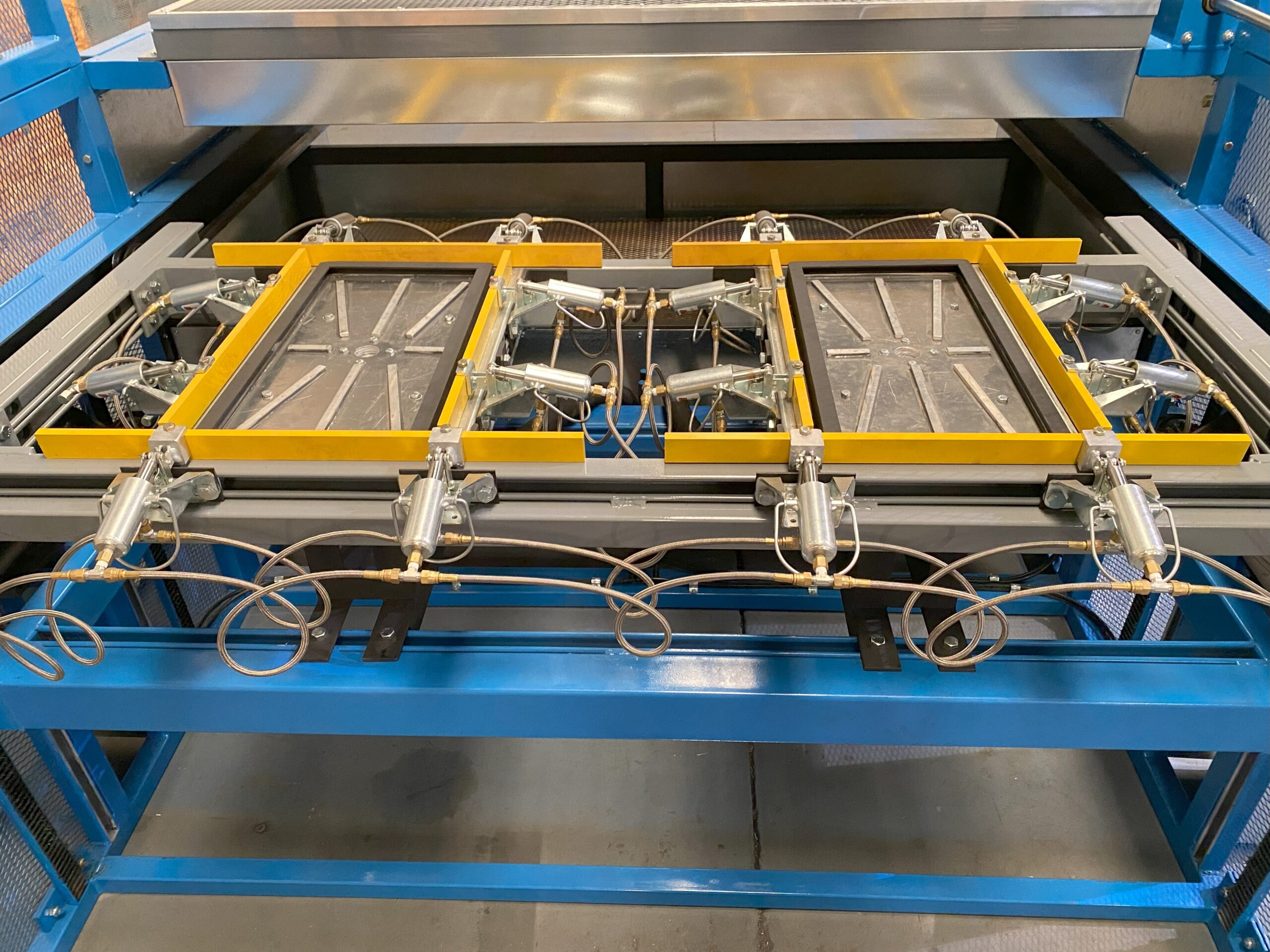
Bringing thermoforming in-house can cut lead times, reduce outsourcing costs, and give your team tighter control over quality. To do it well, your engineers, buyers, and operators need a shared vocabulary. Use this glossary-style guide to align stakeholders, speed equipment selection, and avoid costly mistakes during setup and ramp.
Quick Glossary (Skimmable)
| Term | What It Means / Why It Matters |
|---|---|
| Vacuum Forming | Heated sheet is pulled over a mold by vacuum. Simple setup, lower tooling cost, broad use cases. |
| Pressure Forming | Vacuum + compressed air for higher detail and crisper textures; approaches injection-molded aesthetics. |
| Twin-Sheet Forming | Two sheets formed and fused to create hollow/double-wall parts (pallets, enclosures, ducts). |
| Amorphous vs. Crystalline | Amorphous (e.g., PETG, PC, ABS) has wider forming window; crystalline (e.g., PP, HDPE) needs tighter heat control and often pre-drying. |
| Gauge | Sheet thickness (mil/mm). Thin gauge for packaging; heavy gauge for durable components. |
| Forming Window | Temperature range where a sheet forms cleanly without webbing, orange peel, or tearing. |
| Sheet Orientation | Extrusion direction that influences shrink, impact strength, and warpage; track for quality consistency. |
| Draw Ratio | Depth vs. smallest mold width. Higher ratios mean more thinning risk; informs plug-assist and tooling choice. |
| Plug Assist | Pre-stretches hot sheet for uniform walls and deeper draws; material and surface finish matter. |
| Mold Venting | Micro-vents release trapped air so sheet contacts details; critical for sharp features and textures. |
| Heater Zones | Individually controlled IR zones to tune heat profile, reduce thinning, and balance cycle time. |
| Mold Temperature Control | Chillers/TCUs stabilize mold temp for dimensional accuracy, finish quality, and repeatability. |
| Cycle Time | Total time per part (heat, form, cool, release). Drives throughput and cost per part. |
| Webbing | Unwanted folds that occur during draw; mitigated with heaters, plug shape, and draft/tool changes. |
| Trimming | Removing flash/skeleton via steel-rule die or 3-/5-axis CNC; defines edge quality and finish accuracy. |
Why Learning the Language Matters
When outsourcing thermoforming, most of this terminology stays on the supplier’s side. But once you bring it in-house, your team must use these terms daily—communicating with machine builders, material suppliers, and quality auditors. Understanding concepts like draw ratios, plug assists, and mold venting ensures you can design parts for success, maintain consistency, and avoid unnecessary waste.
With the right foundation in thermoforming vocabulary, your company can confidently select equipment, train operators, and build processes that pay back the investment in your new department many times over.