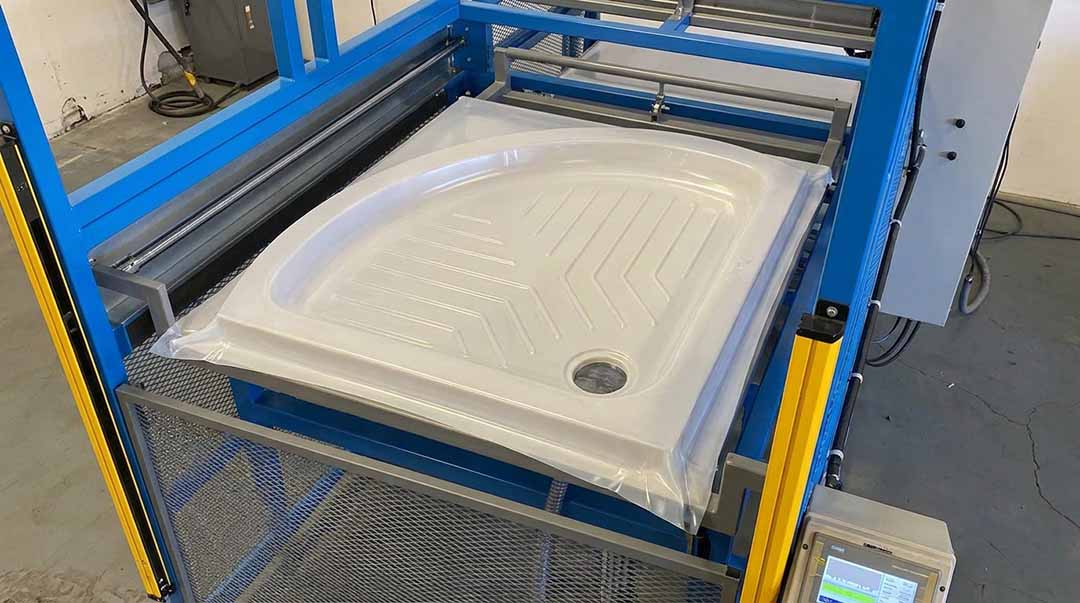
Shower enclosures and tub surrounds are some of the most demanding parts made in custom bath products manufacturing, not because the process is exotic, but because deep draws, large surface area, and a finished surface customers look at every day leave very little room for a design shortcut. Getting the part geometry and material right before tooling begins saves far more than it costs to spec the first time correctly.
Why Shower Enclosures Are a Deep-Draw Design Problem
A one-piece shower surround or tub enclosure typically involves significant depth of draw relative to its footprint, which is exactly the condition where wall thickness becomes hardest to control. According to the SPE Thermoforming Division, the reciprocal of a part’s areal draw ratio approximates its average wall thinning, meaning a deeply drawn shower base or surround loses a meaningful percentage of its starting sheet thickness by the time it reaches the mold floor.
That thinning does not happen evenly. Corners and vertical walls thin faster than flat surfaces, which is why corner radii and side wall geometry on a shower enclosure mold matter as much as overall depth. A mold designed with generous radii and consistent draft distributes material more evenly and reduces the risk of a thin spot becoming a stress crack once the part is in service.

Starting Sheet Thickness Has to Account for the Deepest Point
Because wall thickness drops as the sheet stretches into the mold, the starting gauge has to be selected based on the deepest, most demanding point of the part, not the average. Undersizing the starting sheet to save material cost is one of the more common design mistakes on a first shower enclosure run, and it shows up later as flex, cracking at the drain area, or a surface that doesn’t hold up to repeated cleaning and use.
This is where part design and material spec have to be decided together rather than in sequence. A designer who locks in wall thickness targets without accounting for the draw ratio at the deepest feature, typically the drain sump or an integrated seat, ends up specifying a sheet gauge that looks adequate on paper but thins past a safe minimum exactly where the part needs strength most.
Draft Angle and Undercuts on Curved Enclosures
Thermoformed bathroom products rarely have perfectly flat walls. Corner units, curved fronts, and integrated seat or shelf features all introduce undercuts and compound angles that a flat panel mold never has to deal with. Adequate draft angle on every vertical surface allows the finished part to release cleanly from the mold without dragging, distorting, or leaving drag marks on a visible surface.
Integrated features like a molded-in soap shelf or seat add their own local draw ratio challenges nested inside the larger part, since that feature is effectively a smaller, deeper draw within the bigger one. Mold designers account for this by adjusting radii and draft specifically around those features rather than applying one blanket draft angle across the whole tool. Corner shower units add a further layer of complexity, since the mold has to manage draw depth changing across two intersecting wall planes rather than a single flat surface, which is part of why corner enclosure molds cost more to tool than a straight alcove design.
Material Selection Depends on What the Enclosure Has to Survive
Shower and tub enclosures sit in a wet, temperature-cycling environment for the life of the product, which narrows the practical material choices. ABS is a common choice for its impact resistance and ability to take a cap sheet finish. Acrylic-capped ABS sheet gives manufacturers a glossy, easy-to-clean surface layer bonded to a structural ABS base, a construction used throughout the custom bath products industry specifically because it balances finish quality with impact strength.
HIPS shows up in lower-cost tub surround applications where budget matters more than long-term impact resistance, while heavier-gauge acrylic sheet gets used where a manufacturer wants the finished surface and the structural layer to be the same material rather than a cap sheet system. The right choice for a given product line usually comes down to where it sits in the market, a builder-grade tub surround and a premium custom shower enclosure rarely call for the same sheet spec, even when the mold geometry is nearly identical.
Where Process Control Picks Up From Here
Getting the part design and material right is half the equation. The other half, heating uniformity, vacuum timing, and cooling cycle design, determines whether that design actually forms the way it was engineered to. Belovac’s guide to vacuum forming techniques for bath and shower manufacturing covers that process side in depth, including mold heat channel design, multi-zone heating, and cooling cycle efficiency, and is worth reading alongside this piece for the full picture from design through production.
What to Confirm Before Committing to a Machine Purchase
A few design and equipment considerations separate a shower enclosure production line that runs smoothly from one that fights the process on every cycle:
- Corner radii and draft angles sized for the part’s actual draw depth, not a generic default
- Starting sheet gauge selected against the deepest point of the part, not the average wall thickness
- Clamp frame and heater capacity sized for the full sheet a shower enclosure or tub surround requires
- Material choice, ABS, acrylic-capped ABS, or HIPS, matched to the product’s price point and durability requirements
- PLC repeatability if the goal is consistent wall thickness across a full production run, not just a single good part
Skipping any one of these tends to show up as an inconsistent part, excess scrap, or a design that looked fine on paper but fights the mold in production.
How Belovac Supports Custom Bath Products Manufacturers
Producing shower enclosures and tub surrounds at production volume calls for a machine built for large-format, deep-draw work, not a smaller sheet-fed unit pushed past what it was designed to handle. Belovac’s large format vacuum forming machines are built with the clamp frame size, heater capacity, and vacuum draw needed for this category of part, and the company’s BV A-Class PLC-controlled line adds the repeatability a manufacturer needs to hold consistent wall thickness across a full run.
If you’re evaluating vacuum forming machines for shower enclosure, tub surround, or spa shell production, Belovac’s team can help you match the right machine size and configuration to your part geometry and volume. Request a quote to get started.