
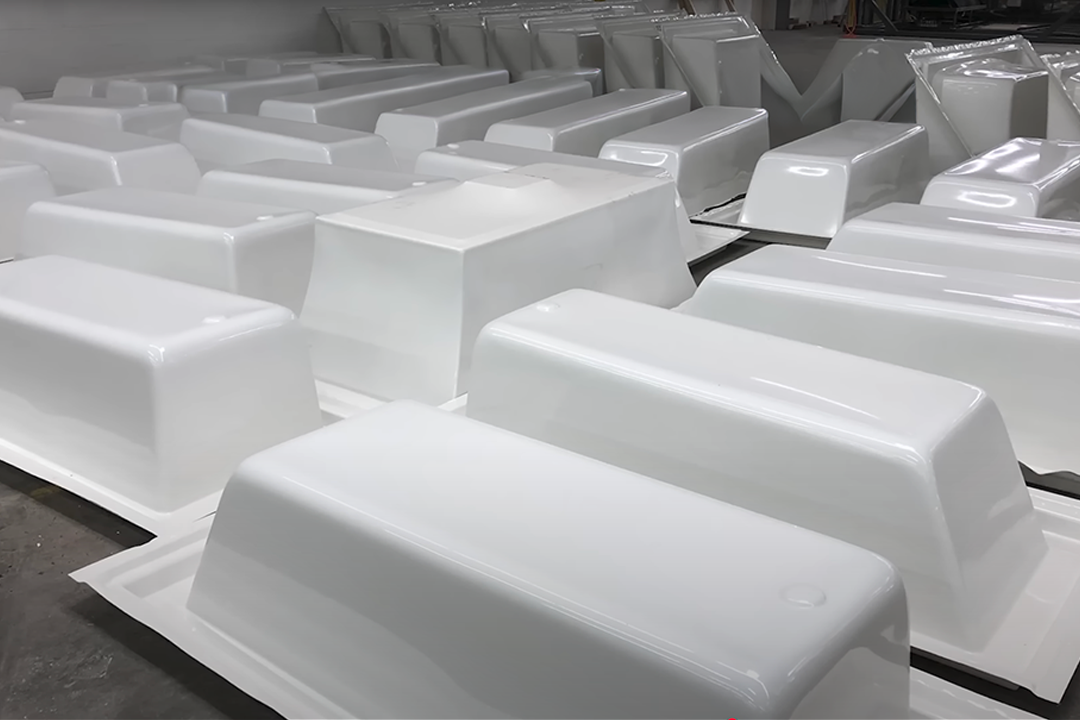
Vacuum forming has become the defining process in bath and shower manufacturing, setting the standard for surface consistency, structural strength, and cycle efficiency. The method transforms heavy-gauge thermoplastic sheets into complex shells that combine design precision with long-term durability. As highlighted in industrial vacuum forming applications, advancements in modern thermoforming systems have refined how manufacturers balance speed, precision, and repeatability in large-scale production.
Precision Mold Design and Material Optimization
Every successful bath or shower vacuum forming process begins with accurate mold engineering. The mold’s geometry determines not only shape and aesthetic appeal but also wall uniformity and product durability. Precision CNC machining of aluminum or high-density composite tooling materials ensures dimensional stability through repeated heating cycles. Proper venting and heat channel design help maintain uniform temperature and pressure distribution across complex contours.
Material performance is equally important. Most bath and shower shells use thermoforming-grade acrylic or ABS composites for their balance of gloss retention, impact resistance, and UV stability. Before forming, each sheet must be conditioned to remove moisture and ensure predictable behavior under heat. Using a precision industrial drying oven helps eliminate trapped humidity, preventing blisters, haze, or micro-bubbles during the forming cycle.
Controlled Heating for Uniform Sheet Performance
Maintaining uniform sheet temperature is critical to achieve a consistent thickness distribution. Overheating can cause sagging or whitening, while underheating results in poor mold definition. The most effective systems employ dual-zone or multi-zone infrared heating arrays with PID-controlled temperature feedback.
Advanced models such as the BV E-Class vacuum forming machine offer precise temperature control across each zone, allowing engineers to manage complex shapes like corner radii and recessed panels without compromising gloss or wall balance. For high-volume operations, continuous inline systems similar to Belovac’s chain-drive roll-fed machines provide constant thermal regulation and faster cycle throughput.
Vacuum Control and Process Timing
The efficiency of vacuum forming depends heavily on how quickly and uniformly the vacuum engages once the sheet contacts the mold. In bath and shower production, delayed or uneven suction can trap air pockets, leaving visible blemishes or uneven draw ratios. Segmenting molds into controlled vacuum zones ensures that deeper contours receive balanced suction intensity.
Modern industrial vacuum forming machines synchronize vacuum timing with plug assist and mold closure, enabling precise control during the critical forming window. Automated valves, responsive sensors, and PLC-based control panels fine-tune pressure and hold duration to maintain consistent shape fidelity and surface finish. This results in smoother textures and reduced rework, critical in maintaining production efficiency.
Cooling, Demolding, and Cycle Time Efficiency
After the forming phase, cooling determines both dimensional accuracy and total cycle time. Uneven temperature reduction can result in warping or stress cracking. Many facilities use water-cooled mold channels or controlled air systems to achieve uniform cooling across large surface areas. Maintaining vacuum pressure during the initial cooling phase helps preserve part geometry and minimizes shrinkage.
Dual-station setups such as the BV Dual Station vacuum forming machine allow heating and cooling to occur simultaneously, reducing idle time between cycles. This overlapping process increases production efficiency while maintaining part quality, a critical advantage in high-volume bath manufacturing where consistent throughput directly supports operational profitability.
Automation and Data-Driven Production Control
Automation is transforming thermoforming into a data-centric manufacturing discipline, supported by research in smart manufacturing that connects real-time data analysis with process optimization and quality assurance. Integrated control systems enable operators to monitor heat distribution, vacuum levels, and cycle timing continuously, allowing immediate adjustments to reduce waste and improve yield. Facilities equipped with PLC-controlled forming units can store multiple forming profiles for different product designs, ensuring quick changeovers and consistent output across shifts.
Modern automation platforms also combine robotic trimming, labeling, and stacking solutions to streamline post-forming operations. By unifying, forming, and finishing within a single workflow, manufacturers reduce manual handling, improve safety, and achieve higher throughput. These integrated systems demonstrate how digital control architecture enhances precision, repeatability, and long-term equipment reliability across high-volume thermoforming environments.
Quality Assurance and Material Traceability
Maintaining high quality across every production batch demands structured inspection systems and robust traceability. Digital process logging captures essential parameters like heating time, vacuum pressure, and cooling rate, enabling engineers to verify consistency and diagnose anomalies. In advanced bath and shower manufacturing, reliable data capture ensures each formed part meets both dimensional accuracy and visual standards.
Embedding barcode tracking or batch-linked labeling into automated lines provides full traceability from raw material to finished product. This approach supports regulatory compliance and strengthens audit capability and supplier accountability. When paired with predictive maintenance programs that monitor heater calibration and vacuum pump performance, overall equipment uptime improves and costly failures are reduced.
Product traceability has become a key component in modern manufacturing. A comprehensive review in the literature explores framework designs, enabling technologies, and implementation strategies across industrial sectors. According to Product traceability in manufacturing, digital traceability systems are increasingly integrated with execution layers to support end-to-end visibility and consistent quality assurance.
How Belovac Advances Bath and Shower Manufacturing
Belovac designs and manufactures precision vacuum forming systems that enhance accuracy, efficiency, and consistency in bath and shower production. With over 30 years of experience, our vacuum forming equipment supports every stage of manufacturing, from material preparation to forming, cooling, and trimming, ensuring consistent quality throughout each production cycle. Belovac delivers:
- Advanced forming systems: The BV A-Class and BV C-Class machines deliver reliable forming precision across multiple material gauges with repeatable performance.
- Large-format capability: Large-format forming systems are designed for bath, shower, and spa shells that require deep-draw forming and uniform temperature balance.
- Energy-efficient drying ovens: Belovac drying ovens remove moisture evenly to prepare plastic sheets for smooth, defect-free forming.
- Comprehensive support: Our team provides consultation, installation, and ongoing service to help manufacturers achieve peak system performance.
All Belovac systems are built in the United States and meet strict industrial standards for reliability and performance. To explore custom configurations or request a detailed quotation, contact our engineering team and discover how Belovac technology can modernize and expand your bath and shower production line.