
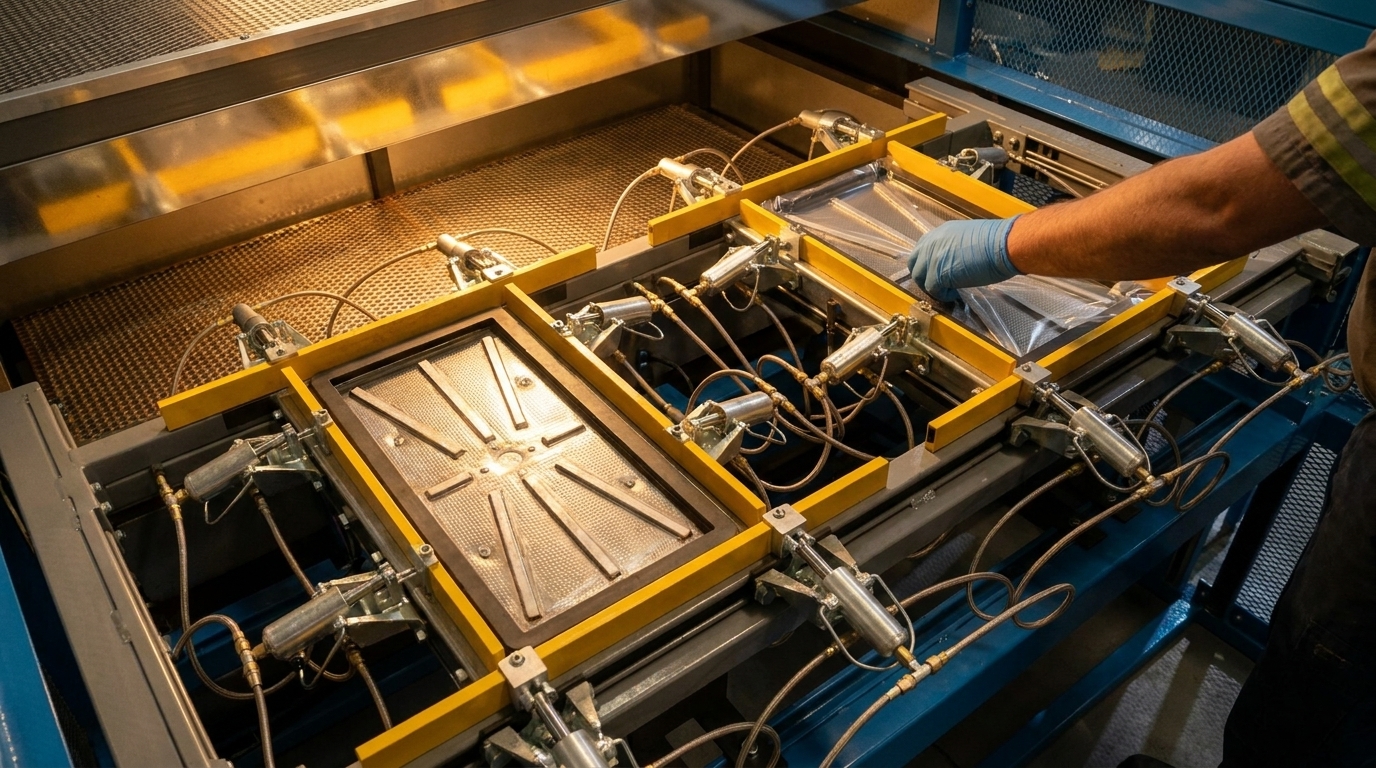
The forming method you choose for a plastic part affects every part of your project: tooling cost, lead time, surface quality, and how well the process scales with your production volume. While vacuum forming is one of the most widely used plastic forming processes across manufacturing, it is not always the right fit for every project. Pressure forming, twin-sheet thermoforming, and injection molding each solve different manufacturing problems.
Knowing where those methods overlap with vacuum forming and where they are superior helps you make the right call before committing to a particular tooling method. Manufacturers evaluating production options can get a closer look at industrial vacuum forming machines to understand what equipment configurations look like across different production scales.
The following comparison focuses on the forming methods most relevant to thermoplastic component production: what each process does well, where its limits begin, and the specific project conditions that favor one over another.
How Vacuum Forming Works in Practice
Vacuum forming is a thermoforming process. A thermoplastic sheet is clamped in a frame, heated until it becomes pliable, and then drawn down over a mold using vacuum pressure. As air is removed from beneath the sheet, atmospheric pressure pushes the material tightly against the mold surface. The part cools in place and is then trimmed to its final dimensions.
The process sounds straightforward, but the variables that determine part quality are real. Heating uniformity affects wall thickness consistency. Mold design determines how accurately the formed part captures detail and handles deep draws. Vacuum pressure and timing need to be calibrated to the specific material being used. Get any of these wrong and you will see thin spots, webbing, or surface defects in the finished part.
From a cost standpoint, vacuum forming is accessible. Molds can be made from aluminum, composite, or even wood for prototype runs, which keeps tooling costs low compared to other plastic forming processes. The method handles a wide range of thermoplastics including ABS, acrylic, polycarbonate, PVC, polystyrene, and polyethylene. Part sizes can range from small packaging inserts to large industrial components like spa shells, RV panels, and automotive interior pieces. Organizations focused on thermoforming industry research and standards continue to document advances in how these materials and processes are applied across production environments.
A broader look at the types of thermoforming methods shows how vacuum forming sits within the larger process family and where each variant takes over based on part geometry and production volume.
Pressure Forming Compared to Vacuum Forming
Pressure forming follows the same basic sequence as vacuum forming but adds positive air pressure above the sheet during the forming cycle. Vacuum pulls from below. Pressure pushes from above. That combination forces the plastic more firmly against the mold, capturing detail that vacuum alone cannot reliably produce.
The practical result is a formed part with sharper edges, defined textures, and cleaner transitions. For applications where surface appearance matters, such as consumer product housings, medical equipment enclosures, or point-of-purchase displays, pressure forming can produce results that visually resemble injection-molded parts at a fraction of the tooling cost.
The trade-off is equipment and tooling complexity. Pressure forming requires enclosed tooling and machinery built to handle the added forming force. That raises the baseline investment compared to standard vacuum forming. For parts where structural performance matters more than cosmetic detail, such as packaging trays, protective covers, and large-format panels, vacuum forming remains the more practical and cost-effective path.
The choice between these two closely related vacuum forming techniques often comes down to one question: how much surface detail does the part actually need? A more detailed breakdown of pressure forming vs vacuum forming walks through the differences in tooling, part quality, and cost to help manufacturing teams make that call.
When Does Twin-Sheet Thermoforming Make Sense?
Twin-sheet thermoforming is a specialized variant of the thermoforming process. Two thermoplastic sheets are heated simultaneously and formed against opposing mold halves. While still hot, the two formed halves are fused together under pressure, creating a single part with a hollow or double-walled interior.
This method is well suited to parts that require enclosed geometry, internal channels, or structural rigidity without added weight. Common applications include:
- Industrial pallets and load platforms that need strength without excess material weight
- Automotive duct assemblies and HVAC components with enclosed airflow channels
- Fuel tanks and fluid containment parts requiring sealed internal cavities
- Medical device enclosures where double-wall construction adds structural protection
- Double-wall containers used in material handling and storage applications
Single-sheet processes cannot replicate these geometries without secondary assembly steps, which adds to the labor cost and creates potential failure points at bond lines. The added complexity of twin-sheet thermoforming is real, requiring synchronized heating and forming on both sides, matched tooling, and precise timing at the bonding stage.
For manufacturers whose parts genuinely require hollow structures, this process is often more cost-effective than fabricating two separate parts and bonding them later. For parts where enclosed geometry is not needed, the added investment is rarely justified.
The Differences between Thermoforming and Injection Molding
Injection molding is commonly compared to thermoforming when manufacturers are evaluating what they need for a new production program. Both processes produce plastic parts at volume, but the economics and part design requirements are fundamentally different.
Injection molding forces molten plastic into a closed metal mold under very high pressure. The process delivers extremely tight tolerances, complex three-dimensional geometry, and consistent part quality across high production volumes. The limitation is tooling cost. Steel injection molds for complex parts regularly run into the tens of thousands of dollars, sometimes higher. Lead times to produce tooling can stretch into weeks or months before the first part is produced.
Thermoforming, including vacuum forming and pressure forming, operates with much lower tooling costs and shorter setup times. The process also handles large surface areas more efficiently than injection molding, which is why industries like automotive, signage, spa manufacturing, and construction use vacuum forming for oversized components that would be impractical to inject-mold at any reasonable cost.
The broader plastics manufacturing industry in the US relies heavily on both methods, with thermoforming serving a distinct and growing share of the market where part size and production flexibility matter most.
The dividing line is usually production volume and part geometry. At very high volumes with small, complex, three-dimensional parts, injection molding becomes cost-competitive once tooling is amortized. At low-to-medium volumes, large-format parts, or designs that are still being refined, thermoforming offers a faster and more economical path to production.
For a direct breakdown of these trade-offs, the comparison between thermoforming and injection molding covers production volume thresholds, tooling considerations, and design constraints in practical terms.
Choosing the Right Plastic Forming Method
No single forming method is right for every project. The decision typically comes down to several factors that need to be evaluated together rather than in isolation.
The following criteria tend to drive the choice between vacuum forming, pressure forming, twin-sheet thermoforming, and injection molding:
- Production volume. Thermoforming methods are best suited to low-to-medium production runs, prototyping, and large-format components. Injection molding makes economic sense only at very high volumes where tooling cost spreads across a large part count.
- Part size and geometry. Vacuum forming handles large, moderately contoured parts efficiently. Injection molding is better for small, complex, three-dimensional shapes requiring tight tolerances across all surfaces.
- Surface detail requirements. If the finished part needs textured surfaces, sharp edges, or a cosmetically defined appearance on the mold side, pressure forming is worth the added tooling investment. If structural coverage matters more than surface texture, vacuum forming is the economical choice.
- Tooling budget and lead time. Lower mold costs and faster tooling production make thermoforming the practical starting point when startup investment and time to first part are constraints.
- Material compatibility. Most industrial thermoplastics, including ABS, acrylic, polycarbonate, PVC, polystyrene, and polyethylene, form well in properly configured thermoforming equipment. If a project requires a material that performs poorly under thermoforming conditions, injection molding or blow molding may be more appropriate alternatives.
Projects that fall cleanly into one category make the decision straightforward. The harder cases are mid-volume programs with moderate surface detail requirements and medium part sizes, exactly the range where vacuum forming and pressure forming overlap. In those situations, running the numbers on tooling cost, expected run length, and surface quality standards will produce a clearer answer than process preference alone.
A thermoforming process reference from the British Plastics Federation provides useful technical context on forming variants, material behavior, and production configurations that can support that analysis.
The Machine Manufacturer Behind the Method
Once the forming method is identified, the equipment behind it has to fit the production requirements. Belovac LLC has been designing and building vacuum forming and thermoforming machines in the United States since 1984. Family-owned and operated for over 40 years, Belovac builds every machine to order at its Southern California facility, with US manufacturing behind each design.
The Belovac lineup covers the full range of production requirements. Each machine series is built around a specific production profile:
- BV C-Class — Manual, sheet-fed vacuum forming machines starting at $8,900. Built for flexible production from entry-level hobbyist work to continuous industrial use, with sheet sizes up to 48″ x 96″.
- BV E-Class — Large-scale manual machines with a dual-oven design. Built for heavy-gauge thermoplastics and deep-draw applications where thorough heat saturation is critical.
- BV A-Class — Fully automated, PLC-controlled thermoformers with sheet-fed and roll-fed configurations. Designed for high-efficiency, high-volume production with consistent cycle times and minimal operator intervention.
- Large Format Machines — Custom-built vacuum forming systems for oversized industrial components including spa shells, skylights, RV panels, signage, and boat parts.
If you are ready to match the right machine to your plastic forming process, the Belovac engineering team is available to help. When you reach out, you speak directly with a design engineer, not a sales representative, who can help you evaluate machine size, configuration, and material compatibility based on your actual production needs. Contact us today to learn more about our products, and for us to help you match the right machine to your production run.