
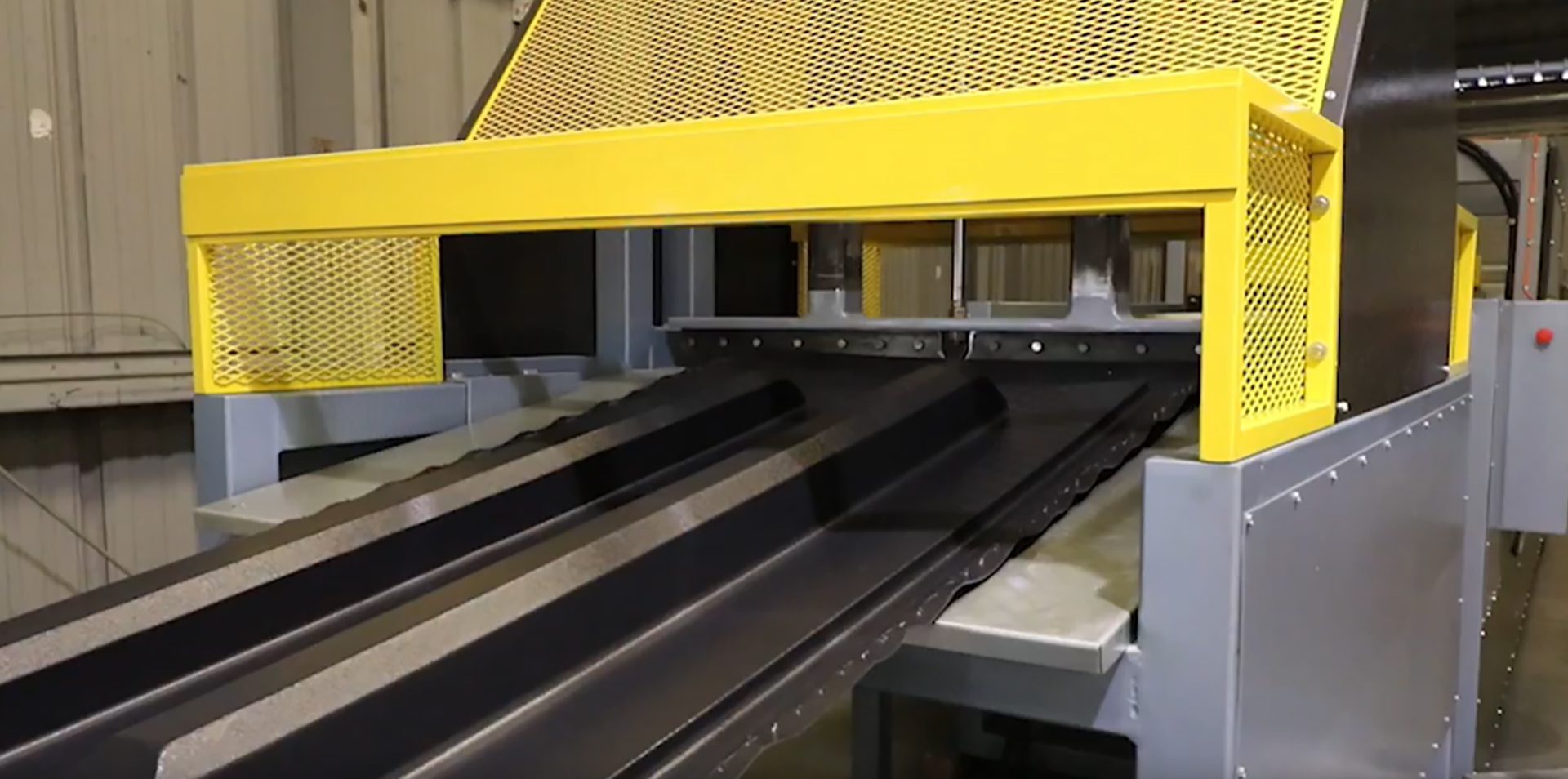
Every vacuum forming machine has a size ceiling, and most manufacturers find it the hard way, mid-production, when a part comes out warped or a mold barely fits the forming area. Large format vacuum forming is the use of vacuum forming machines built for oversized plastic parts that exceed the capacity of standard equipment, with the heat control, clamping pressure, and vacuum consistency needed across a much larger forming area.
Beyond a certain scale, standard equipment isn’t a compromise anymore. It’s the wrong tool. For manufacturers producing parts like spa shells, RV panels, boat hulls, aerospace and automotive components, or large signage, the wrong machine means defects, seams, uneven thickness, and wasted production time instead of a clean part in a single cycle, which is why many operations look at industrial vacuum forming machines engineered for large-scale production. This article looks at where standard machines fall short, which applications call for large format vacuum forming, how machine layouts and specifications differ, and how Belovac engineers large format systems to match the part requirements.
Where the Math Stops Working in Vacuum Forming
A vacuum forming machine sized for trays or blister packs is engineered around a specific set of assumptions: modest sheet size, shallow draw depth, and heat that only needs to travel a short distance evenly. Push that same machine toward a boat hull section, a skylight dome, or a full RV side panel, and every one of those assumptions breaks at once. This is the gap Belovac’s large format vacuum forming machines are built to close.
Heat has to spread across several extra feet of material without losing uniformity. Vacuum has to hold draw pressure over a much larger surface instead of a small one. Clamping has to keep a heavier, larger sheet from shifting or sagging for the full length of the cycle. None of that scales linearly, and machines not built for it usually show the strain as uneven wall thickness or a part that warps once it cools.
The Applications That Actually Require Large Format Plastic Sheet
Large format isn’t a premium upgrade for its own sake. It’s a requirement for specific categories of parts where standard machines physically can’t do the job in one piece:
- Spa shells, hot tub structures, and swim spas that need one continuous forming surface across 8 to 10 feet
- Skylights and architectural panels with broad, shallow-to-moderate geometry
- RV panels, boat hulls, and marine components where wall thickness has to stay consistent edge to edge, especially in vacuum formed RV components and panels
- Aerospace vacuum formed components and automotive parts with dimensional tolerances that can’t drift across a large formed area
- Oversized signage, retail displays, and packaging trays that would otherwise require piecing multiple smaller parts together
Manufacturers sometimes try to work around the size limit by forming a part in sections and joining them, but that trades one problem for another: visible seams, added labor, and a new point where the part can fail. In manufacturing, the process starts by heating a large thermoplastic sheet of plastic material until it becomes soft and pliable, and the material has to withstand elevated temperatures for about one minute without defects; vacuum forming typically uses thermoplastics because common vacuum forming materials are thermoplastics selected to form reliably. Heat has to spread evenly enough to produce consistent vacuum formed components, while vacuum has to hold draw pressure by removing air between the sheet and custom molds to create a tight seal and help the sheet take the required shape, and avoiding issues like webbing, thin spots, or incomplete forming depends on addressing common vacuum forming issues and their fixes. Clamping has to keep the sheet in position and maintain sealing during the process, whether the tool is cast aluminum or built from wood for early projects. That combination is what makes the method cost effective and flexible enough to create large seamless parts for enclosures, panels, and other applications. A machine sized correctly for the part solves it in a single cycle instead, and large format vacuum forming is typically used to create large seamless parts with complex shapes that cool, then get trimmed to the desired shape.
Sorting Real Capability From Spec Sheet Marketing
Large format machines vary more between manufacturers than most buyers expect, and the process can produce lightweight and durable vacuum formed components for packaging, transport, and equipment enclosures once a machine is running production. Three tiers cover most of what’s on the market:
| Configuration | Typical price range | Best fit |
|---|---|---|
| Manual large format, single station | Starting around $20,000 | Lower-volume production or first entry into large format forming |
| Automated large format, PLC multi-zone | Mid-range, scaling with zone count and forming area | Consistent production runs needing repeatable heat and cycle control |
| Fully custom, high-capacity dual station | Can exceed $150,000 | High-volume operations running multiple oversized parts per shift |
In manufacturing, it can replace complex fabricated sheet metal for some projects, particularly when producing vacuum formed automotive interior and exterior components.
Rapid prototyping is also a cost effective advantage because shorter lead times help create parts faster.
Raised-relief maps are one historical example.
Beyond price tier, the specs worth pressure-testing before buying are heater zone count, clamping pressure per linear foot, and vacuum capacity relative to total forming area, not just the headline machine dimensions. A machine can advertise an impressive forming area and still underperform if the vacuum pump system wasn’t sized to match it. Those machine features also affect overall cost, and a vacuum former is typically judged by how well those details support real production needs.
The SPE Thermoforming Division has pointed to heat uniformity and vacuum capacity as two of the most common points of failure as part size increases, and both are a function of engineering, not operator skill.
Belovac’s Approach to Large Format Vacuum Pump Engineering
Belovac has designed and built vacuum forming equipment in Banning, California since 1984, and large format machines are where that engineering experience is most visible. Every large format system uses pneumatic clamping rated up to 300 foot-pounds of pressure per linear foot, paired with a Siemens PLC controlling up to eight independent heating zones. That zone control is what allows a flat panel section and a deep-draw section on the same sheet to each get the heat profile they need, instead of one averaged setting compromising both, and it is one of the machine features that directly affects total cost and production fit.
These systems run ABS, HIPS, KYDEX, acrylic, HDPE, and polycarbonate across manual and fully automatic configurations, with forming areas commonly ranging from 4 by 6 feet up to 10 by 12 feet and draw depths reaching 30 to 40 inches. Small tabletop units can cost a few hundred dollars, while large industrial systems can cost tens of thousands of dollars. Financing through Univest Capital is also available, which matters when the alternative is continuing to outsource oversized parts or run them inefficiently on equipment that was never rated for the job. Vacuum forming is often chosen because tooling costs are far lower than injection molding and avoid multi-million-dollar tooling costs.
For applications that fall outside standard forming areas, Belovac also builds custom large format machines engineered around the exact part dimensions and draw depth you’re working with. Vacuum forming typically fits projects producing about 250 to 3000 units per year.
Matching the Machine to the Part, Not the Other Way Around
Most large format buying mistakes come from sizing the machine to the budget instead of the part. A system rated below what your production actually needs will always be working against itself, no matter how it’s operated. The same zone-controlled engineering that goes into Belovac’s large format line carries over directly into its spa and hot tub forming machines, since spa shells are one of the most common oversized parts manufacturers bring to us.
Configuration matters just as much as raw size. A single custom part run occasionally has very different needs than a shop running dual-station production around the clock, and Belovac’s single vs. dual station guidance walks through how to match configuration to actual volume instead of guessing.
If parts keep coming out of forming with inconsistent wall thickness or your team is piecing together sections to get around a size limit, the machine is almost certainly the bottleneck, not the process around it. Request a quote and we’ll help you spec a large format system rated for what you’re actually producing.