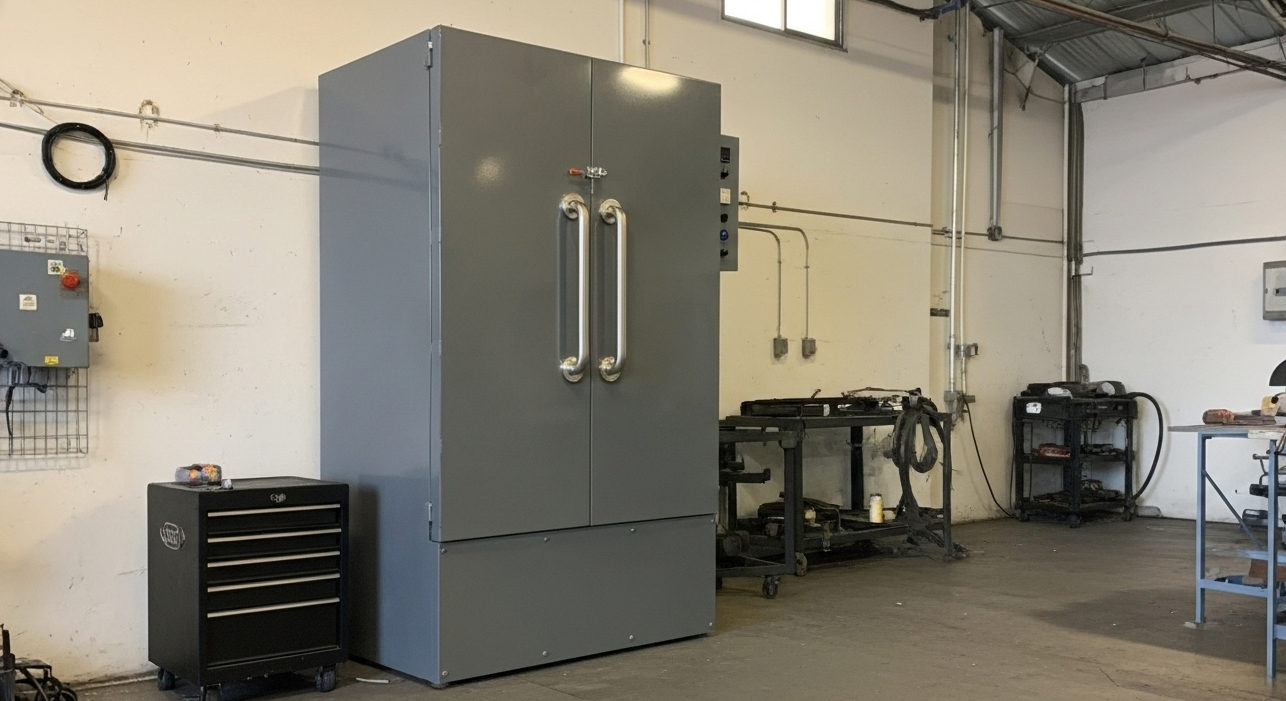
Industrial curing ovens are workhorses in production environments where coatings, adhesives, and paints must reach their full performance properties. The oven curing process ensures that finishes adhere correctly, resist wear, and deliver long service life. For manufacturers comparing an industrial curing oven for sale, the decision often comes down to how reliably the equipment manages heat, airflow, and cycle time.
How the Oven Curing Process Works
At its core, curing is about applying controlled heat to trigger or complete chemical changes in a material. In paint and coating applications, this means cross-linking molecules so the finish hardens properly. The oven curing process typically follows a cycle of heating, holding at the target temperature, and then cooling under controlled conditions.
For example, curing high-temp paint in an oven requires steady exposure to elevated temperatures so the coating bonds uniformly to the substrate. Without accurate temperature control or even airflow, finishes may blister, remain soft, or show uneven gloss.
Types of Curing Ovens Used in Manufacturing
Not all curing ovens are built the same. Manufacturers select equipment based on part size, coating type, production volume, and required finish quality. The right choice can mean the difference between consistent output and costly rework. Below are the main curing oven formats commonly applied across industries.
- Batch ovens: Flexible, suited for mixed part sizes and smaller runs.
- Conveyor ovens: Continuous throughput, ideal for high-volume finishing lines.
- Infrared ovens: Surface heating that accelerates cure time.
- UV curing ovens: Rapid curing for specialized coatings responsive to ultraviolet light.
- High-velocity airflow ovens: Enhanced circulation to shorten dwell times and improve uniformity.
The choice depends on whether the priority is flexibility, speed, surface quality, or energy efficiency.
Industries and Materials that Rely on Curing Ovens
Curing ovens are used anywhere a durable finish or bond is required. Common materials include powder coatings, liquid paints, adhesives, and polymer resins. The industries that depend on them are wide-ranging:
- Automotive: Body panels, trim, and components that need consistent finish quality.
- Aerospace: Lightweight composites and coated parts with strict performance standards.
- Furniture and wood products: Varnishes, sealers, and protective finishes.
- Metal finishing: Powder-coated frames, appliances, and industrial equipment.
- General manufacturing: Adhesives, plastics, and composites requiring controlled curing cycles.
What to Look at When Considering an Industrial Curing Oven for Sale
Selecting the right curing oven is less about technical specs alone and more about matching equipment to production goals. Buyers typically weigh the following factors before committing to a system:
- Temperature range: Can the oven consistently reach the cure temperature required by the coating or adhesive?
- Uniformity: Is heat distributed evenly so all parts cure to the same quality standard?
- Airflow: Does the design promote circulation that eliminates hot and cold spots?
- Controls: Are there simple, repeatable settings for recipes and profiles?
- Safety: Does the system meet required standards for ventilation and operator protection?
- Capacity: Is the oven sized appropriately for the expected part volume and cycle time?
Best Practices in the Oven Curing Process
Even the most advanced curing oven delivers inconsistent results without disciplined process control. Consistency, repeatability, and product quality depend on applying a few proven practices every cycle:
- Start with clean surfaces: Remove dust, oils, and contaminants to ensure adhesion.
- Preheat the oven: Stabilize conditions before loading to avoid uneven starts.
- Hold at cure temperature: Maintain the specified heat for the full required time.
- Allow gradual cooldown: Prevent stress, warping, or premature cracking by cooling under control.
- Inspect cured part: Check hardness, gloss, and bonding strength before releasing parts downstream.
Advantages and Trade-Offs of Curing High-Temp Paint in a Curing Oven
Curing high-temp paint in an oven produces durable coatings that withstand demanding environments, but every approach carries both benefits and limitations. Reviewing advantages, challenges, and trade-offs together helps manufacturers make informed decisions that balance quality, cost, and throughput.
| Category | Key Points |
| Advantages |
|
| Challenges |
|
| Trade offs |
|
Technology Trends Influencing Curing Oven Design
Industrial curing ovens are undergoing rapid change as manufacturers prioritize efficiency, automation, and compliance with environmental standards. According to an industry market report on curing and drying ovens, demand is rising for systems that reduce energy consumption, support hybrid heating methods, and enable smarter production monitoring. These developments are shaping how buyers evaluate ovens and how suppliers engineer new solutions.
- Smarter controls: Data logging and automated recipes for repeatable results.
- Energy-conscious designs: Better insulation and airflow that reduce operating costs.
- Hybrid heating: Combining convection with infrared or UV for faster curing.
- Modular construction: Scalable oven designs that grow with production demand.
- Compliance focus: Systems designed to meet evolving safety and emissions requirements.
Belovac: A Leader in Industrial Curing Ovens
Belovac brings more than three decades of experience designing thermoforming and finishing equipment. Our industrial curing ovens are built in the USA and engineered for reliability in demanding production settings. Each system balances throughput, quality, and energy performance so manufacturers can cure coatings and adhesives with confidence. Belovac’s drying ovens feature:
- Tailored oven curing process design to match coating and material requirements.
- Proven airflow and heating layouts that protect surface quality and consistency.
- Energy-efficient controls that keep operating costs predictable.
- Systems compliant with safety standards and built for long service life.
Companies across automotive, aerospace, and manufacturing sectors trust Belovac to deliver ovens that meet their performance and budget goals. Contact us today to discuss industrial curing oven for sale options and request a quote for your next project.